Home › Areas › Asphalt Paving in Dublin, Ohio
Asphalt Paving in Dublin, Ohio
Dublin sits northwest of Columbus on both banks of the Scioto, and its paving problems are specific: long curved drives under heavy tree canopy, a large stock of 1980s-through-2000s houses whose original surfaces are now at the end of their lives, and neighborhoods where a finished drive is expected to look finished. Quotes are free and come from a local paving company. Call (614) 618-4912 or send the details through the form.
A suburb on both sides of the river, in three counties
Dublin straddles the Scioto River and spills across county lines — most of it in Franklin County, with sections reaching into Delaware County to the north and Union County to the west. That matters less for the asphalt than for the terrain. The land falls toward the river through a set of ravines and wooded draws, and a good share of the residential streets sit on ground that is not flat, with drives that run downhill toward a house or uphill away from one.
The east side, toward Sawmill, is older and denser. The northwest, around Muirfield and the golf-course neighborhoods, is lower density with deeper setbacks and longer drives. Historic Dublin at the bridge is a different animal again: a small limestone-walled village core with narrow lots and almost no room to stage equipment. One city, three different access problems.
The practical upshot is that a Dublin quote depends heavily on getting a truck and a paver to the work. A four-hundred-foot curved drive off Brand Road and a fifty-foot drive behind a building in the old village are priced by completely different constraints, and neither can be judged from a map.
The 1980s through 2000s stock is hitting the wall now
Dublin grew hard from the early 1980s onward, and an enormous share of its housing dates from that run through the mid-2000s. Those houses are now twenty to forty years old, which means a great many of them are on their original driveway or on a single overlay done sometime in the 2000s. Asphalt built right gives fifteen to twenty years in this climate. A lot of Dublin is past that number.
What that looks like on the ground is predictable. The surface has gone gray and dry rather than black. The edges have started to ravel and crumble away because there was never anything supporting them sideways. There are straight cracks running with the direction of the drive, and in the worst areas the cracks have connected into a web. Once the cracking interlinks into polygons, the base has failed, and putting new asphalt over it just gives the same failure a fresh coat.
The good news on that stock is that many of these drives were built on a reasonable base — the lots were graded by developers who expected the houses to sell high — so a genuine overlay is often available where a comparable drive elsewhere would need a rebuild. The only way to tell is to core or cut and look, or at minimum read the crack pattern honestly instead of optimistically.
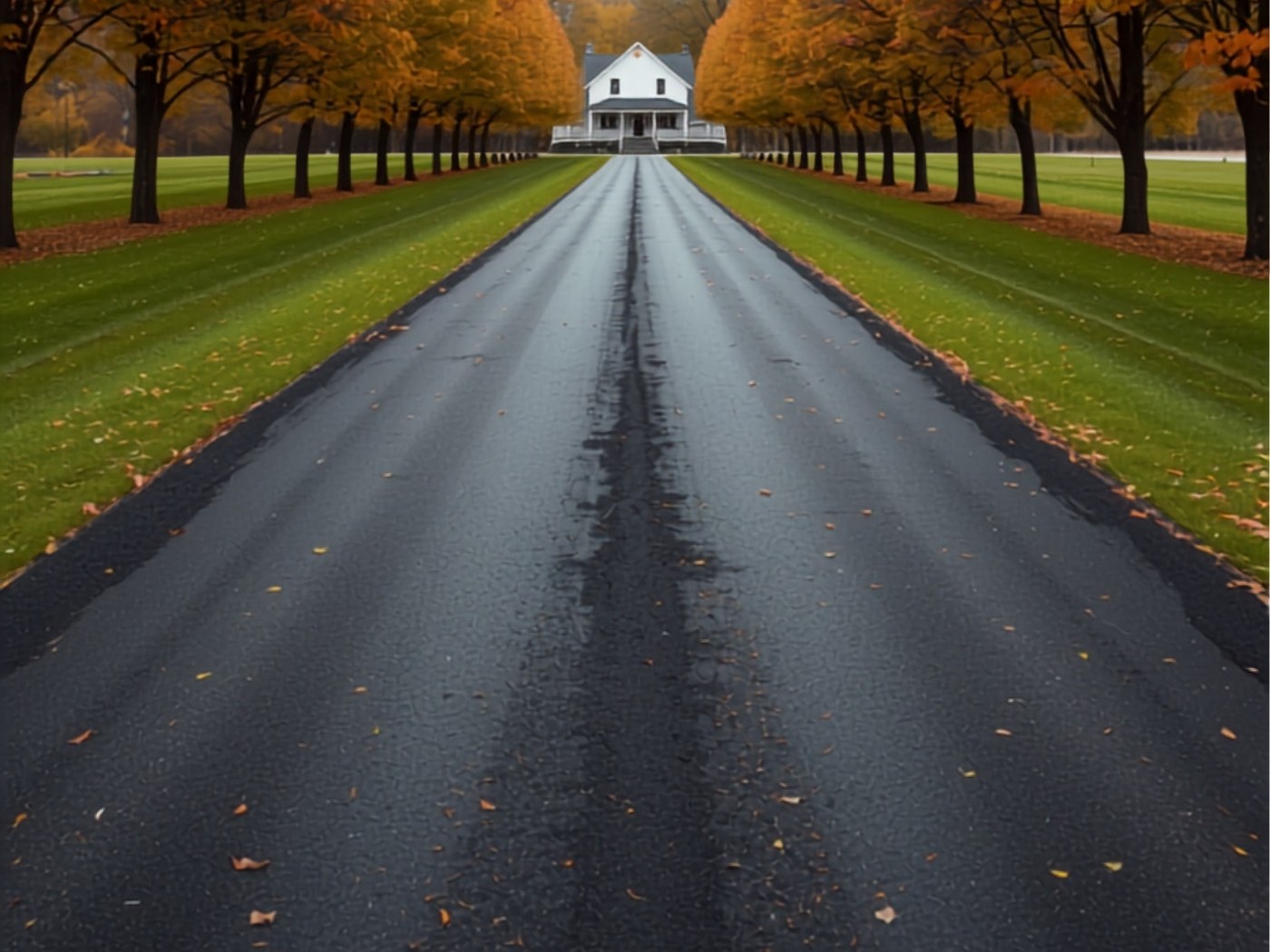
Tree canopy: root heave and a drive that never dries
Dublin's mature neighborhoods have real tree cover, and the city has spent decades protecting it. That canopy does two separate things to asphalt, and they get confused with each other.
The first is root heave. A large shade tree set fifteen feet off a drive will eventually run a structural root under it, and as that root thickens it lifts the surface into a ridge that cracks along its length. You can patch the ridge, and it will come back, because the root is still growing. The real options are cutting and rebuilding that section with a root barrier, rerouting the drive slightly, or accepting a maintenance cycle on that one spot. A paver who tells you an overlay solves root heave is telling you something that is not true.
The second is shade. A drive under heavy canopy stays damp for hours or days after the sun has dried out the neighbor's. That extends every freeze-thaw cycle, keeps moss and algae growing at the edges, and means water sits in cracks instead of evaporating out of them. On a shaded Dublin drive, crack filling before winter matters more than it does on an open lot, and sealcoating cadence is about protecting a surface that rarely gets fully dry rather than one baking in sun.
Leaf litter compounds it. Wet leaves left on asphalt through November hold moisture against the surface and stain it. Keeping a shaded drive swept in fall is not cosmetic maintenance in this part of town.
Long curved drives, and what they cost to do properly
The golf-course neighborhoods and the larger lots north and west of the river are full of drives that curve, branch to a side-load garage, and end in a turnaround or a courtyard apron. These are the most satisfying drives in central Ohio to see done well and the easiest ones to do badly.
Curves are where a paver either earns the job or gives it away. A machine-laid mat wants to run straight; every curve involves feathering, hand-raking at the inside of the radius, and a roller pattern that does not leave a seam ridge on the tangent. Turnarounds and aprons are wide-open areas where a mat has to hold a consistent pitch across a lot of square feet without a birdbath in the middle. Longitudinal joints down the middle of a wide drive are where water finds its way in five years later if they were not rolled hot and tight.
Length also changes the cost structure. On a long run, the tonnage goes up, but so does the exposure: more edge to support, more chances for the grade to wander, more distance for water to travel before it leaves. A four-hundred-foot drive is not eight times a fifty-foot drive — it is a different job with different risks, and it should be quoted as one.
Clay, drainage, and ground that falls toward the Scioto
Under Dublin, like the rest of central Ohio, is glacial till — heavy clay that holds water, swells wet, shrinks in a dry August and heaves in a freeze. Asphalt is flexible; it moves with what is underneath it. That is why the stone matters more than the surface: six to eight inches of compacted aggregate under two to three inches of asphalt is the residential build, and a drive that skipped the stone will fail regardless of the quality of the mat.
The grade toward the river makes drainage both easier and more dangerous here. Easier, because there is usually somewhere downhill for water to go. More dangerous, because a long sloped drive concentrates runoff and can scour the base out from under the low end or wash the shoulder away at the edges. Drives that fall toward a garage are the ones to watch — a garage apron that has settled below grade turns the whole drive into a funnel pointed at the house.
Downspouts are the other repeat offender. A downspout discharging onto the head of a drive will undermine the base from below within a few winters. Fixing the outfall is part of doing the paving properly, not a separate project to worry about later.
Finish expectations, and why they are reasonable
In a lot of Dublin neighborhoods, a driveway is read as part of the front of the house. Homeowners here notice a seam ridge, an edge that wanders, a patch in a different shade, a roller mark left in the mat, and a transition at the garage apron that is not flush. Those expectations are sometimes described as fussy. They are not — every one of them is also a durability signal.
A wandering edge means the mat was not supported while it was rolled. A visible longitudinal seam means the joint went cold before it was compacted, and that is exactly where water will get in. A birdbath that holds a puddle after rain is a low spot that will be the first thing to alligator. A patch in a different shade is only cosmetic, but a patch whose edges are not cut square and sealed is not. Caring what it looks like and caring whether it lasts point in the same direction more often than not.
Many Dublin neighborhoods also have an association that takes an interest in exterior work. If yours does, ask what it wants to see before the work is scheduled rather than after — approvals and staging rules are much easier to deal with in advance than with a loaded truck in the street.
Bridge Street, commercial lots, and multi-family drives
The Bridge Street district has put a dense mix of offices, restaurants, apartments and structured parking into what used to be low-rise suburban ground, and it brought a different kind of paving work with it. Commercial surfaces take concentrated loads that residential drives never see: delivery vans on a tight turning radius, a dumpster set down in the same footprint week after week, a grease trap or a service door with constant traffic on one square of pavement.
That means eight inches or more of aggregate on a commercial build, thicker binder where trucks turn, and dumpster pads treated as their own structural problem rather than as part of the field. Striping is part of the job, not an afterthought — including accessible stalls and fire lanes — and it needs to be redone after any sealcoat, because the seal covers the previous layout completely.
Apartment and HOA drives sit between the two. They carry more traffic than a residential drive and get less maintenance attention than a retail lot, and they usually cannot close. Phasing matters: work laid out so half the drive or half the lot stays open, done in a sequence residents can actually follow. Ask about how the phasing would work at the walk-through, and ask whether the work can be fitted around your business hours.
The season, and booking around it
Asphalt goes down in central Ohio roughly April through October, with the ground above 50 degrees and rising. A mat laid on cold ground cools from the bottom and cannot be compacted properly, which is how a drive ends up with the right thickness and none of the density. Late March and early November are week-by-week judgment calls. Crack filling and some patching stretch further into the shoulder seasons than full paving does.
Dublin's calendar has its own rhythm on top of that. Spring fills with everything that failed over the winter, and early summer is the busiest stretch. If a drive needs to be done before a house goes on the market, or a lot needs to be resurfaced before a tenant opens, start the conversation a season ahead rather than a month.
Weather moves dates and always will. A crew that will not lay a mat in the rain is a crew that will not have to come back and do it twice. Quotes are free, and the paving company prices the actual job after seeing the property — call (614) 618-4912 or send the details through the form.
Services available here
-
Asphalt Paving
New asphalt over a properly built base — the work that decides whether the surface lasts fifteen years or five.
-
Driveway Paving
Residential drives, from a city lot in Clintonville to a four-hundred-foot run out in Union County.
-
Asphalt Repair
Crack filling, pothole patching and full-depth repair — what central Ohio winters make necessary.
-
Sealcoating
Protection, not repair. Done on the right cadence it buys years; done every spring it buys nothing.
-
Parking Lot Paving
Commercial lots, apartment and HOA drives, striping and ADA layout — phased so you stay open.
-
Resurfacing
An overlay when the base is still sound — and an honest answer about when it is not.
FAQ: Asphalt Paving in Dublin, Ohio
My driveway has a ridge where a tree root runs under it. Can that be fixed?It can be addressed, but not by patching the ridge — the root is still growing and will lift it again. The real options are cutting out that section, dealing with the root and rebuilding with a barrier, adjusting the line of the drive, or accepting that the spot needs periodic attention. Under Dublin's older canopy this is one of the most common calls, and the honest answer depends on how large the tree is and how close it sits.
Why does my driveway stay wet when my neighbor's is dry?Shade. A drive under heavy tree canopy can stay damp for a day or more after an open drive has dried, and that extends every freeze-thaw cycle the surface goes through. It also encourages moss and algae at the edges. On a shaded drive, keeping cracks filled before winter matters more than it does on a sunny one, and keeping leaves swept off through November is genuine maintenance rather than tidiness.
My house is from the 1990s and the driveway is original. Does it need replacing?Possibly not. Asphalt built properly lasts fifteen to twenty years here, so an original 1990s drive is at or past that, but the question is the base rather than the age. Straight cracks and a dry gray surface usually mean the structure is fine and an overlay will work. Interconnected cracking in polygons means the base has failed and an overlay will telegraph through it. Someone has to look at the crack pattern to tell you which you have.
Can a long curved driveway be done without visible seams?Largely, yes, if the joints are rolled while they are still hot and the curves are hand-worked at the inside of the radius. A visible longitudinal ridge down the middle of a wide drive usually means the joint went cold before it was compacted, and that is also where water gets in later. So on a curved drive the cosmetic question and the durability question are the same question.
Do you work on HOA and apartment drives in Dublin?Yes — HOA drives, apartment property, private approach lanes and shared parking areas, along with commercial lots. Those surfaces usually cannot be closed, so the work gets phased to keep part of the drive or lot usable throughout. Bring the whole property to the walk-through so the sequence can be planned around how residents actually move through it.
How long do I have to stay off a new driveway?A day or two for cars. The mat keeps curing for weeks after that, so keep off the edges where nothing supports the asphalt sideways, vary where you park at first, and keep motorcycle and trailer stands off it entirely — a point load on new asphalt on a hot afternoon leaves a dent that does not come back out.
How often should a Dublin driveway be sealcoated?Every two to three years on a healthy surface. Doing it every spring is wasted money and can build a film thick enough to crack on its own. On a heavily shaded drive that rarely dries fully, staying on the two-to-three-year cadence and keeping cracks filled is more valuable than sealing more often. Fresh sealcoat needs 24 to 48 hours before traffic, longer in humid weather.
Do I need approval from my association before repaving?Ask them. Many Dublin neighborhoods have an association that takes an interest in exterior work, and requirements vary from one to the next. It is much easier to sort out approvals and any staging or street-parking rules before a date is booked than on the morning a truck arrives. Whatever the association needs to see, get it settled while the quote is being prepared.
Do you pave streets?No. This is private-property work only — residential driveways, commercial lots, HOA and apartment drives, private approach lanes, plus repair, sealcoating, striping and resurfacing. Public streets belong to the city and are a separate matter handled through its own office.
Get a free quote on your driveway or lot
Call and describe the property, or send an email with the address and roughly what you are looking at. The request goes to a paving company working in Columbus and central Ohio. Quotes are free and the paving company prices the job after seeing it.