Home › Areas › Asphalt Paving in Gahanna, Ohio
Asphalt Paving in Gahanna, Ohio
Gahanna is wooded and genuinely hilly by central Ohio standards, built along Big Walnut Creek and Rocky Fork, with a great many original driveways from the 1960s through the 1980s still in the ground. Grade, trees and water decide most jobs here. Free quotes from a local paving company: (614) 618-4912.
Grade Actually Matters Here
Most of Franklin County is flat enough that a driveway's slope is a detail. Gahanna is the exception. The land falls toward Big Walnut Creek and Rocky Fork Creek in real ravines, the older streets follow the contours rather than a grid, and it is common to find a drive that climbs six or eight feet from the street to the garage, or drops the same distance into a walkout basement.
A sloped drive changes the whole job. Water does not sit on it, which is an advantage, but it arrives somewhere at the bottom with momentum, and that somewhere is frequently a garage door. A drive that falls toward an attached garage needs a deliberate destination for the water — a trench drain across the apron, a properly shaped valley that throws it to one side, or a regrade that flattens the last section. Paving a steep drive without solving that is paving a problem.
Slope also affects the pavement itself. On a grade, a vehicle's drive wheels put shearing force into the surface every time it starts up the hill, and that force concentrates where the tires spin — typically just past the apron. Braking coming down does the same in the other direction. Asphalt on a steep drive wants proper compaction more than flat asphalt does, and it wants a base that is not going to creep.
In winter the slope becomes the whole story. A north-facing drive in a wooded Gahanna lot may not see direct sun for weeks, which means it stays wet, refreezes overnight, and gets treated with more salt than a sunny drive ever needs. Salt does not eat asphalt, but it keeps the surface cycling through freeze and thaw on days it would otherwise stay frozen, and that cycling is what opens the cracks.
1960s to 1980s Housing and Driveways Long Past Their Life
A great deal of Gahanna is ranch and split-level housing built from the early 1960s through the mid 1980s, in the neighborhoods that filled in around the old village and spread north and east. Many of those drives are original, or were resurfaced once in the 1990s and have not been touched since. Asphalt built right runs fifteen to twenty years in central Ohio and longer if it is sealed sensibly and the cracks are kept shut. Nothing runs forty.
What that looks like on the ground is a drive that has gone gray and porous, with cracking that has connected into a many-sided pattern in the wheel tracks, edges that have crumbled back into the grass, and a low spot at the apron where the car sits. That connected pattern is alligator cracking, and it means the base underneath is no longer carrying load. Once the surface is failing that way, a new layer over the top cracks through in the same pattern within a couple of years.
Split-level lots complicate the diagnosis a little, because the drive often serves a garage set below grade or at an angle to the house, and the failure is not evenly distributed. The straight run may still be sound while the turning area in front of the garage is completely gone. Full-depth repair of one section is a legitimate answer in that situation, and it is a great deal cheaper than replacing the whole thing.
The honest version of this conversation separates three states. A drive with straight, isolated cracks and firm footing has years left and needs crack filling. A drive with a sound base and a worn surface is a good overlay candidate. A drive that is alligatored, soft underfoot, or pumping water when a car rolls over it needs removal and a rebuilt base, and anything else spends the money twice.
Mature Trees: Roots, Shade, Damp and Staining
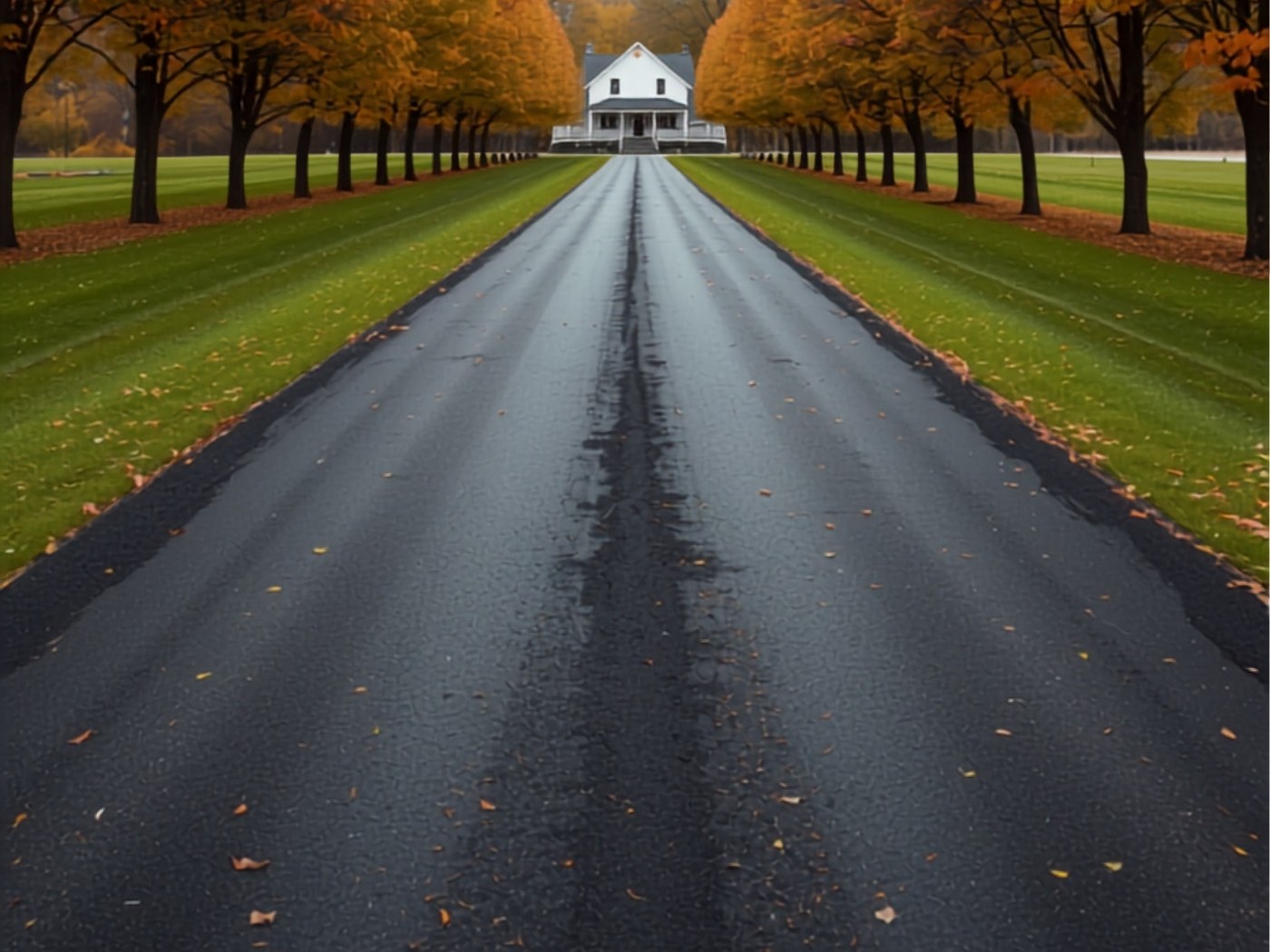
Gahanna's tree canopy is one of the nicest things about it and one of the hardest things about the pavement. Large hardwoods planted or left standing fifty years ago now have root systems running directly under driveways, and roots do exactly what they look like they do — they lift the slab in a ridge, usually running diagonally, and they keep lifting.
There is no surface treatment that fixes root heave. Filling the crack over a root buys a year. The real options are cutting out the heaved section, dealing with the root properly, rebuilding that portion of the base and repaving it, or in some cases accepting that the tree and the driveway are in genuine conflict and choosing one. A good estimate will say which it is rather than quoting a patch and walking away.
Shade causes a slower problem. A drive under heavy canopy stays damp for days after the rest of the neighborhood has dried. Persistent moisture keeps the surface soft, encourages moss and algae in the low spots, and feeds every crack continuously rather than occasionally. In winter it is the drive that refreezes every night. Grade and drainage matter more under trees than in the open, because nothing is going to evaporate quickly.
Leaf litter is the last of it. Leaves left to mat down over a wet autumn stain asphalt and hold moisture against the surface all winter, and in the worst cases they clog whatever drain or swale the drive relies on. Clearing them before the first hard freeze is unglamorous and genuinely extends the surface. Sealcoating over a surface that has been under wet leaves needs the drive properly cleaned first or the sealer will not hold.
Creekside, Olde Gahanna and the Older Core
The original village core around Mill Street and Granville Street, with Creekside sitting on the bank of Big Walnut Creek, is a different environment again. The lots are older and tighter, the streets are narrow, some properties are served from a rear alley, and the pavement being worked on is often shared or has an ambiguous edge where one property's apron becomes the next one's.
Access is the practical issue. Equipment has to get in and out without blocking a narrow street any longer than necessary, and there is rarely room to stage material where it does not matter. Those jobs get planned around the neighbors, the parking, and the time of day, and the planning saves more than it costs.
The pavement in that part of town also tends to have history. Layers over layers, old chip-and-seal underneath, sections that were patched by three different people over thirty years. When a drive near the creek has been built up above the surrounding grade, the water it used to shed now runs along the edge and back underneath it. That is a rebuild rather than another overlay, and it is usually accompanied by getting the drainage right for the first time in decades.
Proximity to the creek brings its own caution. Ground near a ravine or a floodplain edge holds water differently, and the base under a drive there needs drainage designed into it rather than assumed. Central Ohio clay already holds water and heaves; clay that is near a watercourse and shaded by trees is the hardest version of that.
Freeze-Thaw, Clay and Why Cracks Cannot Wait
Underneath the hills, Gahanna sits on the same glacial till as everywhere else in central Ohio: clay that holds water rather than passing it, swells when saturated, shrinks in a dry August and heaves when it freezes. On a slope, that heaving is not uniform — the uphill and downhill portions of a drive move differently, which is why long sloped drives develop cracks running across them.
Central Ohio crosses 32 degrees dozens of times in a single winter. It is not a brutally cold climate, and that is precisely the problem. A hard, continuous freeze does relatively little. A winter that thaws every few days drives water into every opening, freezes it, widens the opening, thaws, lets the water in deeper, and repeats. Forty cycles of that turns a hairline crack into a seam and a seam into a pothole.
That is the entire argument for crack filling on a schedule. Anything wider than a quarter inch takes filler before winter. It is the cheapest work in the trade and it is the work that decides whether a drive with eight good years left actually gets them. A crack left open in October is a repair in April.
The other defense is keeping water off the base in the first place. Downspouts that discharge onto the drive, a swale that has silted in, a trench drain full of last year's leaves, a low spot at the apron that ponds every storm — those are all cheap to correct and all of them shorten pavement life significantly when ignored.
Commercial Lots, Apartment Drives and Association Property
Gahanna has a substantial amount of private commercial pavement. The office, warehouse and service buildings on the airport side of the city, the retail along Granville Street and the Morse Road corridor, church and school lots throughout the neighborhoods, and a large stock of apartment and condominium drive that belongs to an owner or an association.
Commercial builds differently from residential. Eight inches or more of compacted aggregate is the starting point, with a thicker binder course laid where trucks turn, where they back to a dock, and in the dumpster pad footprint. A garbage truck concentrates enormous load in one small footprint, repeatedly, in the same spot every week, and that is why the pavement in front of an enclosure fails long before the rest of the lot. Building that area heavier from the start is cheaper than rebuilding it every four years.
On a lot near the airport corridor with delivery traffic in and out all day, the turn radii and the approach to any dock take the worst of it. Those areas can be built to a heavier section without paying for heavy section across the entire property, and identifying them correctly at estimate time is where the money is saved.
Striping goes back down after any sealcoat or resurfacing, and that includes accessible stalls with their access aisles and any fire lane markings the property carries. For a condominium or homeowners association, the sensible approach is putting the private drives, parking bays, crack work, sealcoat and striping on one schedule rather than reacting building by building. Ask about handling the whole property at once and about phasing it so residents always have a way in and out.
Season, Scheduling and What Cures When
Paving in central Ohio runs roughly April through October, and the mat needs ground above 50 degrees and rising. Hot mix that hits cold ground loses heat before the roller can compact it, and asphalt that was not compacted properly will never perform correctly regardless of how it looks the first week.
Gahanna's shade adds a wrinkle. A heavily wooded lot warms later in the spring and cools earlier in the fall than an open one two miles away, so the practical window on a particular drive can be narrower than the general season. Early April on a north-facing drive under mature trees is often not the same conditions as early April on an open cul-de-sac.
Everyone calls in March, so spring commits first. Late summer into early fall frequently offers the best combination of warm ground, broken humidity and genuine availability. Sealcoat in particular wants a dry stretch with warm nights rather than one warm afternoon, and needs 24 to 48 hours before traffic, longer when the humidity is up.
After new asphalt goes down, normal car traffic is fine in a day or two. The outside edges stay vulnerable much longer because nothing supports them from the side, so keep tires off the last few inches for several weeks. Keep point loads off entirely for a while — trailer jacks, motorcycle stands and basketball hoop bases will dent fresh asphalt long after it stops feeling tacky. On a sloped Gahanna drive, that also means being deliberate about where a car is parked for the first stretch.
What Moves the Number on a Gahanna Quote
This site does not price work and nothing here is an offer. The paving company prices the job after standing on it. What is worth knowing in advance is which factors move the figure, so a quote reads as sensible rather than arbitrary.
Square footage starts it, but slope, access and site conditions move it as much as area does. A steep drive needs more careful compaction and sometimes a different equipment plan. A wooded lot with tight access and a fence line costs more than an open one. Removing and hauling away the old surface is a real line item. Root excavation, base rebuilding, grade correction, a trench drain at the garage, and any apron or curb work all add.
On overlay versus replacement, compare cost per year of service rather than the number today. An overlay on a sound base is genuinely good value. An overlay on a base that has already failed is the most expensive option on the table, because the same money gets spent again in two or three years to do it properly. A useful estimate says plainly which case a drive is in and why, and says so even when the answer is that a few hundred dollars of crack filling is all it needs this year.
Estimates are free and come from a local paving company. Call (614) 618-4912 or send the quote form with rough dimensions, a note about the slope, and a photo of the worst section.
Services available here
-
Asphalt Paving
New asphalt over a properly built base — the work that decides whether the surface lasts fifteen years or five.
-
Driveway Paving
Residential drives, from a city lot in Clintonville to a four-hundred-foot run out in Union County.
-
Asphalt Repair
Crack filling, pothole patching and full-depth repair — what central Ohio winters make necessary.
-
Sealcoating
Protection, not repair. Done on the right cadence it buys years; done every spring it buys nothing.
-
Parking Lot Paving
Commercial lots, apartment and HOA drives, striping and ADA layout — phased so you stay open.
-
Resurfacing
An overlay when the base is still sound — and an honest answer about when it is not.
FAQ: Asphalt Paving in Gahanna, Ohio
My driveway slopes toward the garage and water runs to the door. Can that be fixed?Yes, but not with a surface layer. The water needs a destination, which usually means a trench drain across the apron, a shaped valley that throws it to one side, or a regrade that flattens the bottom section. Repaving a steep drive without solving the water is repaving the problem.
A tree root has lifted a ridge across my driveway. What are the options?Nothing applied to the surface fixes root heave. Filling the crack over the root buys a season. The real choices are cutting out the heaved section, addressing the root, rebuilding that portion of base and repaving it, or deciding between the tree and the drive. Any estimate that just quotes a patch is not being straight with you.
My drive is always damp and green in spots under the trees. Does that shorten its life?It does. Shade keeps the surface wet for days after the rest of the street has dried, which feeds every crack continuously and refreezes every night in winter. Grade and drainage matter more under heavy canopy than in the open. Clearing leaves before the first hard freeze also helps more than people expect.
The driveway is from the 1970s and has never been replaced. Can it be resurfaced?It depends entirely on the base. If the cracking has connected into a many-sided alligator pattern, if it feels soft underfoot, or if it pumps water when a car rolls across it, the base has failed and an overlay will crack through in the same pattern within a couple of years. Straight, isolated cracks and firm footing usually mean an overlay is fine.
Only the area in front of my garage is destroyed. Do I have to redo the whole drive?Often not. Turning areas and parking aprons take far more abuse than the straight run, so it is common for one section to be gone while the rest is sound. Full-depth repair of that section, done properly with the base rebuilt, is a legitimate fix and much cheaper than replacing everything.
Does salt on a steep shaded drive cause damage?Salt itself does not eat asphalt. It keeps the surface thawing and refreezing on days it would otherwise stay frozen, and that added cycling is what widens cracks. A shaded north-facing drive gets salted more and stays wet longer, which is why crack filling matters more on those than on a sunny open drive.
How often should a driveway here be sealcoated?Every two to three years on a healthy drive. Annual sealcoating is wasted money and eventually builds a brittle film that cracks on its own. Under trees, the surface has to be properly cleaned of leaf residue and growth first, or the sealer will not hold. Allow 24 to 48 hours before driving on it, longer in humidity.
Our condominium association needs the private drives done. How is that handled?Phased, so residents always have a way in and out. Crack work, repairs, sealcoat and striping across the whole property can go on a single schedule rather than being handled building by building as complaints arrive. That usually costs less per square foot and creates one disruption instead of several.
When is the best time of year to schedule?Paving runs roughly April through October with ground above 50 degrees and rising. A heavily shaded Gahanna lot warms later and cools earlier than an open one, so the window on a specific drive can be narrower. Late summer into early fall often gives the best mix of conditions and availability. Crack filling should be finished before winter.
Get a free quote on your driveway or lot
Call and describe the property, or send an email with the address and roughly what you are looking at. The request goes to a paving company working in Columbus and central Ohio. Quotes are free and the paving company prices the job after seeing it.