Home › Services › Driveway Paving in Columbus, Ohio
Driveway Paving in Columbus, Ohio
A driveway is the one piece of pavement you use every single day and the one most likely to have been built thin. What separates a drive that lasts twenty years from one that is patched at year six is decided in the week it goes in.
City Lots and Long Rural Runs Are Different Jobs
A driveway in Clintonville, Grandview Heights or German Village is often a narrow strip between two houses, forty to seventy feet long, with a garage at the back and a couple of feet of clearance on either side. The work there is a tight-access job. Equipment has to fit, spoil has to be carried out rather than pushed, the neighbor's property line is right there, and there is frequently nowhere obvious for water to go, which makes drainage the hardest part of the design rather than an afterthought.
Out in Union County, Madison County or the stretches around Plain City, Marysville and Lewis Center, the same word means something else entirely: a three-hundred-foot run from the road to the house, sometimes longer, often crossing a ditch and a culvert, occasionally on ground that rolls. The paving itself is straightforward. The variables are the length, the ditch crossing, whether the culvert under the entrance is sound, how much of the run sits in a low spot that collects water, and whether the property needs a turnaround because backing three hundred feet onto a road is not a reasonable thing to do every day.
Suburban drives in Dublin, Westerville, Hilliard, Powell, New Albany, Pickerington or Gahanna sit in between, and they bring their own constraints: an HOA that has opinions about materials and appearance, a fixed garage apron elevation, mature landscaping close to the edges, and a sidewalk crossing. Same trade, three different sets of problems, and a quote written without looking at which one you have is not really a quote.
The Build Under a Driveway
Whatever the shape, the structure is the same. Topsoil and anything soft comes out. The subgrade gets compacted and checked, and soft pockets get dug out and replaced with stone rather than buried. Six to eight inches of crushed aggregate goes in, placed in lifts and compacted so the depth is real after rolling rather than before it. Then two to three inches of asphalt goes over that, laid hot and rolled while it is still workable.
The reason the stone matters more than most homeowners expect is what it sits on. Central Ohio is glacial till — dense clay that holds water instead of draining it, swells when it is wet, and shrinks in a dry August. A mat laid on that clay with four inches of stone under it will crack in the wheel tracks the first spring the ground goes soft. A properly compacted eight-inch base spreads the load wide enough that the clay never sees a concentrated hit, and it keeps water from sitting directly against the underside of the asphalt.
If a drive is going to take anything heavier than cars — an RV, a loaded trailer, a boat, a work truck parked in the same spot every night — that is worth saying out loud before the quote is written. Heavier loads want more stone and often a thicker mat in the area where the weight sits, and adding it during construction costs a fraction of repairing the depression it makes later.
The Tie-In at the Street and the Garage Apron
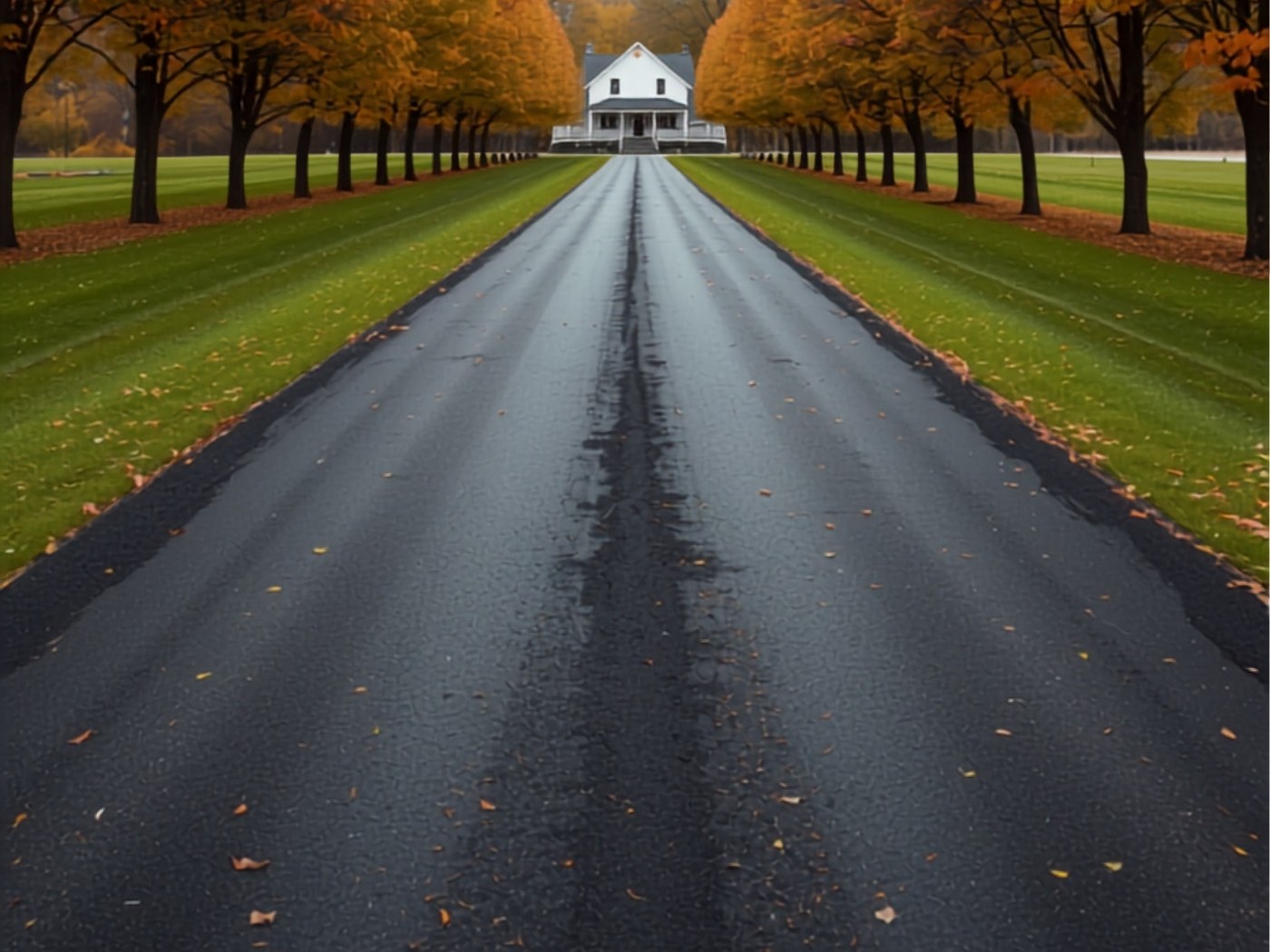
Both ends of a driveway are the parts you see up close every day, and both are where sloppy work shows fastest. At the street, the new surface has to meet the existing edge at the right elevation and at full thickness. That means saw-cutting or milling a clean vertical face on whatever is already there, tacking it, and building the new material up to match, so the joint is a tight seam rather than a thin smear of asphalt feathered out over the old edge. Feathered joints are always the first thing to break up, because asphalt shaved down to a quarter inch has no strength at all.
The transition also has to be graded so a car does not scrape. Where the road crowns and your drive rises, the apron area needs enough of a transition that a low front end clears it, and where the drive drops off the road the same problem appears in reverse. This is easy to set correctly on the day the base is graded and awkward to fix afterward.
At the top, asphalt meets the concrete garage apron. The concrete is fixed in elevation, so the asphalt gets built to meet it flush, with a clean cut and a tack coat on the concrete face so the seam holds. The pitch in the last several feet must run away from the garage, not toward it. Water that arrives at the garage door is water in the garage, and the fastest way to get there is a drive that sags in the final ten feet. If the existing grade makes that unavoidable, a trench drain across the apron is the fix, and it should be discussed before anyone excavates.
Widths, Turnarounds and Parking
Ten feet is the narrow end of a usable single-car drive and twelve is far more comfortable, especially with a car door opening and a landscaping bed alongside. A genuine two-car width runs sixteen to twenty feet. The extra feet on a short city drive are cheap relative to the total and they change how the space actually works day to day, so it is worth deciding deliberately rather than defaulting to whatever the old drive happened to be.
A parking pad beside or in front of the garage is one of the most useful additions on a suburban lot, and it is the place to add a widened area for a trailer or a second vehicle. On longer rural runs, a turnaround is not a luxury. A simple hammerhead or a teardrop loop near the house means nobody reverses the full length of the drive onto a county road in the dark, and it is dramatically cheaper to include while the equipment is already on site.
Think about where a delivery truck or a dumpster would sit, where snow gets pushed, and where the trash containers go. Snow pushed against a garage or into a spot that drains back onto the drive causes a recurring ice problem all winter. A few minutes on the layout before anything is excavated is the cheapest improvement available on the whole job.
Crown and Pitch: Water Has to Leave Sideways
The single most important design feature on a driveway is that water gets off it quickly, and on most drives that means shedding sideways rather than running the length. A crown — a slight peak down the centerline with a fall to each side — pushes water into the lawn within a few feet of where it lands, which is where it should go. On a drive that slopes across instead, a consistent cross-pitch to one side does the same job.
A quarter inch of fall per foot is a practical working target. On a twelve-foot-wide drive that is an inch and a half of crown at the center, which nobody notices underfoot and which drains reliably. Flat does not stay flat: settlement, even in a well-built surface, turns a perfectly level drive into a collection of shallow ponds. Every one of those ponds is a place where water sits long enough to find a hairline opening and go in.
That is what makes drainage the whole ballgame here. Central Ohio winters are not brutally cold, they are wet and oscillating, crossing thirty-two degrees dozens of times in a single season. Water in a crack freezes and widens it, thaws and travels deeper, and repeats. A drive that sheds water within minutes of a rain simply does not give that cycle anything to work with. A drive with standing water hands it fresh ammunition every single storm.
On long runs, water also moves down the length of the drive and has to be intercepted before it gains speed and washes out an edge or floods a low area near the house. Broad swales alongside, a properly sized culvert at the road, and a slight roll in the profile all do that work.
Asphalt, Concrete or Gravel: An Honest Comparison
Asphalt costs less to install than concrete for the same area, goes down fast, and handles freeze-thaw movement well because it flexes rather than fracturing. It can be sealed and it can be patched invisibly enough. It also needs that maintenance — sealcoat every two to three years on a healthy surface and crack filler on anything wider than a quarter inch before winter — and it softens in direct July sun, which is why point loads leave dents in it.
Concrete costs substantially more up front, lasts a long time when it is properly jointed and built on good base, and asks almost nothing of you in maintenance. Its weaknesses in this region are real though: it is rigid, so ground movement cracks it rather than bending it, and those cracks are permanent and visible. Repairs are conspicuous because a patch never matches. De-icing salt genuinely damages concrete surfaces, and on a driveway that gets salted every winter that is a slow, cosmetic loss.
Gravel is the cheapest to install by a wide margin and it is a legitimate answer on a very long rural run where paving the whole thing is out of proportion to the property. It is also an ongoing chore: it migrates into the lawn, it needs grading, it needs new stone added every couple of years, it ruts in a wet spring, and snow removal drags the stone around. Many people on long drives split the difference and pave the first stretch at the road and the area near the house while leaving the middle in stone.
For most Columbus-area homes, asphalt wins on cost-to-durability, and it handles this particular climate's constant movement better than a rigid surface does. Salt is worth one clarification since it comes up every time: salt does not chemically eat asphalt. What it does is keep water liquid at lower temperatures and drive more freeze-thaw crossings, and that cycling is the actual damage.
Converting an Existing Gravel Drive
Homeowners with gravel often assume the stone already there counts as the base and paving is just a matter of laying asphalt over it. Sometimes that is nearly true and sometimes it is not true at all, and the difference is worth establishing before the quote.
What usually happened over the years is that stone was added to the surface repeatedly while the original layer sank into the clay and mixed with it. What looks like eight inches of gravel is frequently three inches of clean stone sitting on five inches of stone-and-clay slurry that has no structural value. Clay-contaminated base does not lock together and does not carry load, and asphalt over it will fail the same way it fails over bare clay.
The honest approach is to open it and look. If there is a real depth of clean, compactable stone, it can be reclaimed: reshaped, topped up with new aggregate to full depth, and compacted into a proper base, which does save meaningful money against building from scratch. If it is contaminated, it comes out, and sometimes a geotextile fabric goes down between the clay and the new stone to stop the two from mixing again. Either way, grade gets re-established in the stone before any asphalt arrives, because a gravel drive that has been rutting for a decade has a profile full of dips that will otherwise be reproduced exactly in the finished surface.
Trees, Roots and What Happens Along the Edges
Mature trees along a driveway are usually the reason you liked the property, and they are also a long-term problem for the pavement. Roots grow where water and oxygen are, which is generally the top foot or two of soil, and they will grow under a drive and lift it. The heave is unmistakable — a smooth ridge running parallel to the trunk, cracked along its crest.
There are limited honest options. Cutting roots relieves the heave but can destabilize or kill a large tree if it takes too many on one side, so it is a real trade-off rather than a free fix. A root barrier installed along the edge during construction redirects new growth downward and is worth doing when a big tree is close. Sometimes the right answer is shifting the drive's alignment a few feet away from the trunk while it is being rebuilt, which is easy when everything is already open and impossible later.
Edges take abuse in general. They are supported on one side only, so any tire that runs off the pavement breaks material away. Backfilling soil flush to the edge after paving is the standard preventive measure, because an edge with a three-inch drop beside it is an edge that will crumble. Keep mulch beds from burying the edge as well, since soil piled over the asphalt holds moisture against it and speeds up deterioration.
Curing and Getting Through the First Winter
New asphalt is drivable in a day or two for cars, but it has not finished hardening. It continues to cure over weeks and months, and through the first warm season it will soften noticeably in direct afternoon sun. That is normal and it is not a defect, but it does mean the first several weeks call for some care.
Practical rules for that period: keep off the outside edges, do not park a heavy vehicle in exactly the same spot every night, avoid turning the steering wheel while the car is stopped, and keep concentrated point loads off the surface. That last one catches people out — jack stands, trailer tongue jacks, motorcycle kickstands and the feet of a basketball hoop will all press into a new mat on a hot day. A scrap of plywood or a steel plate under any of them solves it.
The first winter is usually uneventful on a new surface. Plowing is fine, though a plow blade with a rubber or poly edge, or shoes set to ride slightly high, avoids gouging. Salt is fine on new asphalt in the sense that it will not dissolve it, but limiting it is still sensible because every extra melt-refreeze cycle works on the surface. Sealcoating is not a first-year task. Let the surface cure through a season, then seal on a two-to-three-year cadence and keep any crack wider than a quarter inch filled before winter, and a driveway built this way here runs fifteen to twenty years.
Getting a Driveway Quote in Central Ohio
Driveway pricing comes off the property itself. Length and width, how much material has to be excavated and hauled away, access for equipment and trucks, what the existing surface is and whether any of it can be reused, drainage work, and the amount of stone the subgrade turns out to need all move the number in ways nobody can estimate from a satellite image.
Quotes are free and they come from a local paving company working in Columbus and central Ohio. This site does not price jobs. Call (614) 618-4912 or send the details through the quote form, and someone who does this work will walk the drive and give you a real figure with the build written out, so you can see what is going under the asphalt and not just what goes on top.
FAQ: Driveway Paving in Columbus, Ohio
How much does a new asphalt driveway cost in Columbus?It depends almost entirely on site conditions rather than square footage alone. Excavation depth, hauling the old material away, equipment access, drainage work and how much stone the subgrade needs all move the total, and a long rural run is a different job from a narrow city drive. A local paving company will look at the property and price it for free.
How long does a driveway take to install?Most residential drives are a one- to three-day job depending on size and whether an old surface has to come out. A common sequence is demolition and excavation on the first day, base placement and compaction on the second, and paving on the third. Bad weather pushes it, since asphalt cannot be laid on a wet base.
Can I pave over my gravel driveway?Sometimes, and it has to be checked rather than assumed. Years of adding stone on top usually leaves a layer of clean gravel over a mixture of stone and clay that has no structural value. If there is real depth of clean, compactable stone it can be reshaped, topped up and reused as base. If it is clay-contaminated, it has to come out.
Which is better for a driveway, asphalt or concrete?Asphalt costs less to install, goes in faster and flexes with ground movement, which suits central Ohio clay and freeze-thaw well. Concrete lasts longer and needs almost no maintenance, but it cracks rather than bending, repairs are always visible, and de-icing salt damages the surface. Asphalt asks for sealcoating and crack filling in exchange for a lower price and better tolerance of movement.
How wide should my driveway be?Ten feet is the minimum that works for a single car and twelve is noticeably more comfortable once a door opens. A true two-car width is sixteen to twenty feet. On longer drives, adding a parking pad or a turnaround while the equipment is already on site costs far less than coming back for it later.
Why does water stand on my driveway?Either it was built flat instead of crowned, or it has settled into low spots, or the water is being sent somewhere that cannot take it. Water needs to shed sideways off the surface quickly, and about a quarter inch of fall per foot does that without being noticeable. Standing water is the beginning of nearly every asphalt failure in this climate.
Will tree roots ruin a new driveway?They can, and the damage shows up as a smooth ridge running parallel to a nearby trunk with cracking along the top of it. A root barrier installed along the edge during construction redirects new growth downward, and shifting the alignment a few feet from a large trunk is sometimes the better answer. Cutting major roots relieves the heave but can seriously harm the tree.
When can I park on a new asphalt driveway?A day or two for normal car traffic. For the first few weeks, keep off the outside edges, vary where you park rather than loading the same spot nightly, and do not turn the wheel while the car is standing still. Keep jack stands, trailer jacks and kickstands off the surface or set a plate under them.
Is salt going to damage my new driveway?Salt does not chemically attack asphalt the way it attacks concrete. What it does is keep water liquid at lower temperatures and create more freeze-thaw crossings, and that cycling is what widens cracks and does the real damage. Using less of it and keeping cracks filled matters more than avoiding it entirely.
When should a new driveway be sealcoated?Not in the first season. Fresh asphalt needs time to cure and release its oils before a seal goes on, so the usual advice is to wait until it has been through a full year. After that, every two to three years on a healthy surface is the right cadence, and doing it annually is money spent for no added protection.
Get a free quote on your driveway or lot
Call and describe the property, or send an email with the address and roughly what you are looking at. The request goes to a paving company working in Columbus and central Ohio. Quotes are free and the paving company prices the job after seeing it.