Home › Services › Asphalt Repair in Columbus, Ohio
Asphalt Repair in Columbus, Ohio
Most asphalt in central Ohio does not fail all at once. It tells you what is wrong first, in the shape of the cracks, and the repair that works depends entirely on reading that correctly.
What Asphalt Repair Actually Covers
Asphalt repair is a range of work, not one service. On the light end it is filling cracks so water stops getting under the surface. In the middle it is cutting out a failed area and rebuilding it. On the heavy end it is admitting that the patching has run its course and the surface needs to be replaced. A paving company that only offers one of those is going to sell you that one whether or not it is the right answer.
The useful way to think about a driveway or a lot is in two layers. There is the asphalt you can see, usually two to three inches of it on a residential drive over six to eight inches of compacted aggregate. And there is the base underneath, which is doing almost all of the structural work. Surface problems are cheap. Base problems are not. Nearly every repair decision comes down to figuring out which one you are looking at.
The other thing worth knowing up front is that repair is time-sensitive in a way that most home maintenance is not. A quarter-inch crack left open through one central Ohio winter is a wider crack with a softer base under it by spring. The same crack filled in September is a non-event. Very little else on a property rewards acting early quite that directly.
How Central Ohio Winters Break Asphalt
The damage mechanism here is not cold. It is water plus repeated freezing. Columbus does not get the sustained deep freeze that locks the ground solid for months; it gets a wet, oscillating winter that crosses 32 degrees dozens of times between November and March. Every one of those crossings is a cycle, and cycles are what destroy pavement.
Here is the sequence, step by step. Rain or snowmelt finds an open crack and runs down into it. Overnight the temperature drops and that water freezes. Water expands as it turns to ice, so it pushes outward on both faces of the crack, widening it by a fraction of a millimeter and breaking a few more aggregate points loose along the edges. The next afternoon it thaws. Now the crack is slightly wider than it was, so it holds slightly more water, and that water sinks slightly deeper. That night it freezes again. Repeat that forty or fifty times over one winter and a hairline crack becomes a quarter-inch crack, and a quarter-inch crack becomes something with a soft, saturated base under it.
Central Ohio sits on glacial till, which makes this worse. Till is heavy clay that does not drain. Water that gets through the asphalt does not disappear into gravel and sand the way it would on a well-drained site; it sits in the clay under your driveway, saturates it, and then that saturated clay heaves when it freezes and shrinks back when it dries out in August. The asphalt on top has to move with it, and asphalt is not good at moving.
Franklin County runs salt and brine on the roads all winter, and it comes up your driveway on your tires and drips off your wheel wells. The salt itself is not eating your asphalt — that is the common misunderstanding. What salt does is lower the freezing point of the water sitting in your pavement, which means the pavement crosses the freeze line more times per winter than the air temperature alone would cause. Salt does not dissolve asphalt. It multiplies the cycles that break it.
Reading the Cracks: What Each Pattern Means
Hairline cracking is the earliest and least alarming. Thin, shallow, often barely visible until the surface is wet and they show as dark lines. On a young surface these are usually shrinkage from the mat curing and losing its lighter oils. They are not structural, but they are doorways, and the whole game in central Ohio is keeping water out.
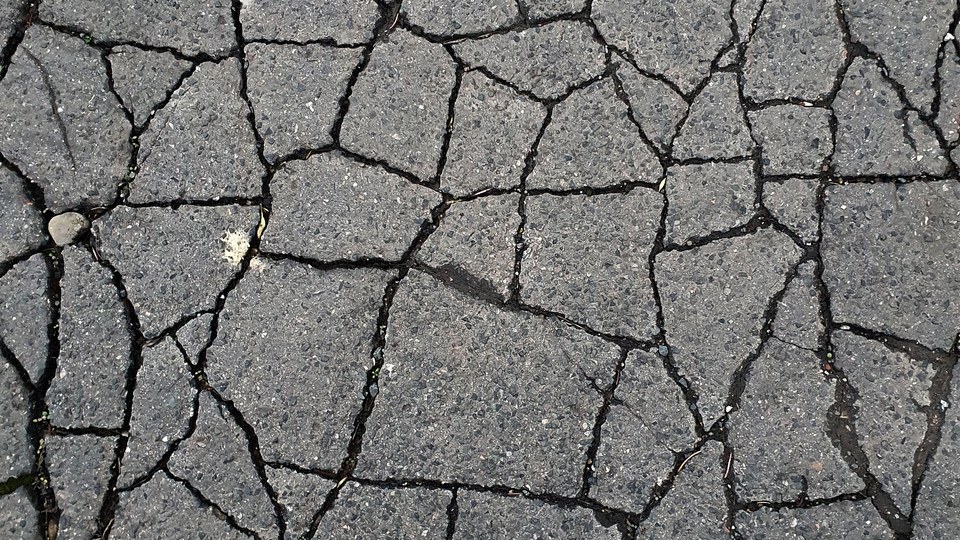
Block cracking is a pattern of connected rectangles, usually a foot or several feet across, with no wheel-path concentration. It is an aging signal, not a load signal. It means the binder in the asphalt has oxidized and gone brittle, so the mat can no longer flex through the daily temperature swing and cracks itself into blocks to relieve the stress. Block cracking on an otherwise solid drive is a strong argument for sealing, because oxidation is exactly what sealer slows down.
Longitudinal cracks run the same direction as traffic — down the length of a driveway, along the drive lanes of a lot. They frequently open along a paving joint, where two passes of the paver met, which is the natural weak seam in any mat. Transverse cracks run across the surface, perpendicular to travel. Those are usually thermal: the asphalt contracts in cold weather, cannot shrink without pulling apart somewhere, and splits across its narrow dimension. Both are normal, both are fillable, and both get much worse if you leave them open through a winter.
Edge cracking shows up as cracking and crumbling within a foot or so of the unsupported outside edge of the pavement. It happens because the edge has nothing lateral holding it — no curb, and often a lawn that has been mowed down an inch lower than the asphalt over the years, so the shoulder no longer supports it. Add a delivery truck that clips the edge, or a lawn that stays wet, and the edge breaks away. The repair is real, but the permanent fix usually involves regrading the shoulder so soil supports the edge again.
Alligator Cracking Means the Base Has Failed
Alligator cracking is a web of interconnected cracks in small, irregular, roughly palm-sized pieces, concentrated where vehicles sit and where they turn. It looks like reptile skin, which is where the name comes from. It is the single most important pattern to be able to identify, because it is the one that changes the answer from repair to replace.
What alligator cracking means is that the base has failed underneath. The asphalt above it is no longer supported, so every time a wheel passes it flexes, and asphalt that flexes repeatedly fatigues and fractures into that characteristic web. The cracks are a symptom. The base is the disease. Usually the base failed because water got into it and stayed there — the glacial till held it, the freeze-thaw worked it, the aggregate lost its interlock and turned into something closer to mud.
This is why patching an alligatored area is usually a waste of money if it is done as a surface patch. Putting fresh asphalt on top of a failed base gives you a fresh surface over the same soft ground, and it will alligator again in a year or two, typically faster than the original did because the patch edges are new seams. The honest answer is either full-depth repair of that area — cut it out, dig down, rebuild the base, then pave — or, if the alligatoring is spread across a large share of the surface, replacement.
The practical threshold most pavers use is proportion. A couple of isolated alligatored patches on an otherwise sound driveway are a full-depth repair job, and the rest of the drive can then be sealed and kept. When alligatoring covers a large share of the surface and shows up in multiple separate areas, you are paying to rebuild the driveway in pieces at a worse price than rebuilding it once. That is also the line where an overlay stops being an option: you overlay when the base is sound, and you replace when it is alligator cracking.
Potholes, Raveling, Birdbaths and Depressions
A pothole is the end state of the freeze-thaw sequence. Water got in, cycled, broke the base down, traffic punched through the weakened asphalt, and then the hole itself started collecting more water and got bigger fast. Potholes grow at an accelerating rate because a hole is a better water collector than a crack. That is why the same pothole you ignored in February is twice the size in April.
Raveling is the surface coming apart grain by grain. You see loose aggregate on the surface, a rough sandpapery texture underfoot, and dark spots where the fines have washed out. It means the binder holding the aggregate together has oxidized and given up, either from age, from sun exposure, or from a mat that was laid too cold and never compacted properly. Light raveling on a structurally sound drive is a candidate for sealing. Heavy raveling that has taken real thickness off the surface is a resurfacing conversation.
Birdbaths are the low spots where water stands after rain and does not drain within a day. Any standing water on asphalt is a problem, because it is a permanent supply for the freeze-thaw cycle right where the surface is already lowest. Some birdbaths are grading problems from the original build. Some are depressions that formed later, which is more serious because a depression that appeared over time means the base under it is consolidating or washing out.
A depression is a settled area, usually broader and smoother than a pothole, often with cracking around its rim. Patching the surface of a depression without addressing what is underneath just moves the low spot down an inch. The right approach is to find out why it settled — a base that was never compacted properly, a utility trench backfilled loosely, a downspout discharging onto one spot for a decade — and fix that first.
Crack Filling Versus Crack Sealing
These two terms get used interchangeably and they are not the same thing. Crack filling means putting material into a crack to block water. Crack sealing means preparing the crack first — routing or cleaning it to a consistent shape, blowing it out, and then installing a material chosen to stay flexible and move with the crack as it opens and closes through the seasons. Filling stops water this season. Sealing is intended to keep stopping it through the movement cycle.
The material matters. A cold pourable filler out of a pail is genuinely useful on a residential driveway with narrow cracks and it is what most homeowners use, but it is relatively rigid and it tends to shrink as it cures, so it needs topping up. Hot-applied rubberized crack sealant is melted in a kettle and poured or wanded into the prepared crack, where it cools into a flexible material that stretches as the crack opens in January and compresses as it closes in July. On a lot, or on a driveway with cracks that are already working seasonally, hot rubberized material is the one that holds.
The threshold worth remembering is a quarter inch. Anything wider than a quarter inch takes filler before winter, no exceptions, because a quarter-inch crack is already wide enough to accept meaningful volumes of water and deep enough to deliver it to the base. Below a quarter inch, hairline cracks are generally better handled by sealcoating the whole surface than by trying to treat them individually.
Prep is most of the job and it is where cheap crack work fails. Material poured into a crack full of dirt, grass and old crumbling filler is glued to the debris, not to the asphalt faces, and it pulls out. A crack that is cleaned out properly — wire-wheeled or routed, blown clean with compressed air, dry when the material goes in — holds for years. If someone quotes crack filling and the plan does not include cleaning the cracks out, that is the part being skipped.
Surface Patching, Full-Depth Patching and Infrared
A surface patch, sometimes called a skin patch or overlay patch, means cleaning the damaged area, applying a tack coat, and laying new asphalt over the top of the existing surface. It is fast and it is the least expensive option, and it is the right call in exactly one situation: when the base below is sound and the damage is limited to the top surface. Used anywhere else it is a cosmetic fix with a short life, because it does nothing about what is underneath.
Full-depth patching is the real repair. The failed area is saw cut in a clean rectangle, generally cut back past the visible damage into solid asphalt, because the edges of the failure extend further than the cracking shows. The old asphalt is removed. The base is excavated to whatever depth it takes to get down to material that is still competent, and that means someone has to actually look at what comes out — saturated clay and loose aggregate have to come out, not get paved over. New aggregate goes in and gets compacted in lifts, not in one dump. Then asphalt goes back in, usually in two lifts on a heavier repair, compacted hot, and the seams get sealed. Done properly a full-depth patch is a permanent repair of that area.
Infrared patching heats the existing asphalt in place with an infrared unit until it is workable, rakes it out along with added fresh material, and recompacts it. Its advantage is the seam: because the existing material is reheated and blended rather than cut, the patch fuses into the surrounding pavement with no cold joint for water to attack. That makes it well suited to potholes, sunken utility cuts, and small isolated defects on an otherwise sound surface. The limitation is that infrared only treats the asphalt layer. If the base under the defect has failed, reheating the surface does not fix it, and the patch will fail again.
One point that gets glossed over on every kind of patch: compaction is what decides whether it lasts. Asphalt that is shoveled in and tamped with the back of a rake looks fine on the day and starts breaking up by the following spring. Asphalt that gets rolled or plate-compacted while it is hot, in lifts of a reasonable thickness, is dense and closed and holds water out. Ask how a patch is going to be compacted.
Where Repair Stops Being Worth It
There is a real line past which repair money is money thrown away, and any paving company worth talking to will tell you where it is rather than quoting patch after patch. The clearest signal is the share of the surface that is alligatored. When base failure is showing up in several separate areas and covering a meaningful portion of the drive or lot, the full-depth repairs needed will approach the cost of replacement, and you will have a patchwork surface at the end of it instead of a new one.
The second signal is drainage that cannot be corrected at the surface. If water stands in multiple places, if the grade runs toward the garage or toward the building, or if the surrounding soil stays wet, patching is treating the symptom while the cause keeps working. Sometimes the fix is regrading and a drain, done once, and then the pavement above it can be repaired or replaced with a reasonable expectation of lasting.
The third is age plus condition together. Asphalt built right runs fifteen to twenty years in central Ohio, longer if it has been sealed on a sensible cadence and the cracks have been kept shut. A twenty-two-year-old drive with widespread block cracking, raveling and two potholes is not a repair candidate; it has done its job. A nine-year-old drive with the same potholes and a sound base absolutely is.
The middle ground is resurfacing. If the base is sound and the problem is genuinely confined to the surface — oxidation, block cracking, raveling, a rough but stable mat — an overlay puts a new wearing course over the existing structure and is meaningfully less expensive than a full tear-out. The condition is that the base has to be sound. Overlay when the base is sound; replace when it is alligator cracking. There is no version of that rule that bends.
Timing Repairs Around the Central Ohio Calendar
The paving season here runs roughly April through October, and hot-mix work needs ground above 50 degrees and rising. That is a genuinely short window for a state that spends five months freezing and thawing, and it means the repair calendar has a logic to it worth planning around.
Spring is when the damage announces itself. The potholes that opened in February are visible, the cracks have widened, and everyone in Franklin County calls a paver in the same three weeks. Spring is a fine time for patching and full-depth repair once the ground has warmed, and it is when most emergency work gets done.
Late summer into early fall is the best time for crack work, and it is the appointment most people miss. Cracks are at their narrowest in warm weather, which sounds like a disadvantage but means the material goes in and then has room to stretch when the crack opens in winter rather than being squeezed out. More importantly, it means the work is finished before the freeze-thaw season starts rather than after it has already done another year of damage. If you are going to fill cracks once a year, fill them in September.
Cold weather closes the window on anything involving hot mix. Asphalt laid on frozen or near-freezing ground does not compact — it stiffens before the roller can close it up — and a patch placed that way comes apart. Cold patch material exists and it is genuinely useful as a temporary measure to keep a pothole from growing over the winter, but it is a stopgap. It is not a repair, and the proper fix should be on the schedule for spring.
FAQ: Asphalt Repair in Columbus, Ohio
How do I know if my driveway needs repair or replacement?Look at the crack pattern. Straight cracks, block cracks and isolated potholes on an otherwise solid drive are repair work. A web of interconnected cracks in small pieces — alligator cracking — means the base underneath has failed, and where that covers a large share of the surface you are looking at replacement. A paving company should be willing to walk it with you and point at what they are seeing.
What is the widest crack that can just be filled?Anything wider than a quarter inch takes filler before winter, and cracks up to roughly an inch are still straightforward filling and sealing work. Beyond that, once a crack is wide enough that the edges are crumbling or you can see loose base material down inside it, the area usually needs cutting out and patching rather than filling.
Is road salt destroying my driveway?Not directly. Salt does not dissolve or eat asphalt. What it does is lower the freezing point of water sitting in and under the pavement, which pushes the surface through more freeze-thaw crossings per winter than air temperature alone would. The cycling is what breaks asphalt, and salt accelerates the cycling. Keeping cracks sealed matters far more than avoiding salt.
Will a patch match the rest of my driveway?Not at first. New asphalt is much darker than aged asphalt and a fresh patch will be obvious for a season or two until it oxidizes toward the same gray. Infrared patching blends better than a cut-and-fill patch because the surrounding material is reheated rather than cut. If appearance matters, sealcoating the whole surface after the patches have cured evens out the color.
Can potholes be fixed in the winter?They can be stabilized, not properly repaired. Cold patch material can be shoveled into a pothole to stop water collecting and keep it from growing through the rest of the winter, which is worth doing. But hot mix needs warm ground to compact, so the actual repair belongs on the spring schedule. Treat winter work as holding the line.
Why does water stand on my parking lot after it rains?Either the original grade was too flat in that area, or the base has settled and created a depression. If the standing area has cracking around its rim, settlement is the likely cause and the base needs attention, not just a surface patch. Standing water is worth fixing because it feeds the freeze-thaw cycle continuously at the lowest and often weakest point of the surface.
What is the difference between crack filling and crack sealing?Filling puts material into a crack to block water. Sealing prepares the crack first — cleaning or routing it, blowing it out — and uses a flexible material, usually hot-applied rubberized sealant, designed to stretch and compress as the crack moves through the seasons. Sealing costs more per foot and lasts considerably longer, which is why it is the usual choice on commercial lots.
When is the best time of year to have cracks filled?Late summer into early fall. The cracks are narrow in warm weather, so the material goes in and has room to stretch when winter opens them back up, and the work is complete before the freeze-thaw season begins rather than after another winter of damage. September is close to ideal in central Ohio.
How long does full-depth patching take?A typical residential full-depth repair area is usually done in a day, including saw cutting, removal, base rebuild and paving. Larger commercial areas depend on how much base has to come out and how many lifts of aggregate go back in. Cars can generally be back on new asphalt in a day or two, and you should stay off the edges for a few weeks while it cures.
Who prices the repair, and does a quote cost anything?Quotes are free and they come from a local paving company that comes out and looks at the surface. Nothing on this site prices a job — repair pricing depends on square footage, how much base has to be removed, access for equipment and how the damaged areas are distributed, and none of that can be judged from a description over the phone.
Get a free quote on your driveway or lot
Call and describe the property, or send an email with the address and roughly what you are looking at. The request goes to a paving company working in Columbus and central Ohio. Quotes are free and the paving company prices the job after seeing it.