Home › Services › Sealcoating in Columbus, Ohio
Sealcoating in Columbus, Ohio
Sealcoat is protection, not repair. Done on a sensible cadence over a sound surface it buys years of life; done as a way to hide damage it buys a season of looking better and nothing else.
Sealcoat Is Protection, Not Repair
This is the thing to understand before anything else, because almost every disappointment with sealcoating traces back to it. Sealer is a thin coating applied on top of asphalt. It is roughly the thickness of a few sheets of paper. It has no structural strength, it carries no load, and it is not a paving material. What it does is protect the surface underneath from the things that age it.
So sealcoat does not fix cracks. A crack that is sealed over is still a crack, and within one central Ohio winter the surface movement will open it right back through the coating. Sealcoat does not fix a failing base — if the ground under your driveway has gone soft, a coating on top of the asphalt is irrelevant to that problem. Sealcoat does not fix potholes, it does not level a depression, and it will not rescue a drive that needs replacing. Applied to a drive that is alligator cracking across a large share of its surface, sealer produces a uniform black drive that is still structurally finished, and the customer feels cheated within a year.
What it is genuinely good at is slowing down the two processes that kill an otherwise healthy surface: oxidation from sun and air, and water getting into the asphalt's surface pores. That is a real benefit with real value, and it is the entire honest case for sealcoating. It is worth doing. It is not worth doing for reasons it cannot deliver on.
A useful way to hold it: sealer extends the life of good asphalt. It does not restore bad asphalt. If someone is selling sealcoating as the answer to a driveway that is coming apart, they are selling the wrong thing, and the right conversation is about repair or resurfacing instead.
What Sealer Actually Is and What It Does
The sealers used on driveways and lots are emulsions — a liquid carrier holding fine solids and additives in suspension, mixed with water and usually sand or a similar aggregate before application. The two families in common use are refined tar based products and asphalt based products. They behave somewhat differently in wear and in appearance, and a paving company will tell you which they run and why; some property owners and some communities have a preference, and it is a fair question to ask before work is scheduled.
The mechanism is straightforward. Asphalt is aggregate held together by a petroleum binder. Ultraviolet light and oxygen attack that binder, driving off its lighter components and leaving it progressively harder and more brittle. That is what turns a black driveway gray and it is why old asphalt cracks under temperature change it used to absorb without complaint. A coat of sealer sits between the binder and the sun and slows that oxidation down.
The second job is water. Asphalt is not a solid sheet; the surface has pores, and in central Ohio those pores fill with water that then freezes, expands and works the surface apart grain by grain. That is what raveling is. A sealed surface sheds water rather than absorbing it into the top layer, which takes a meaningful amount of freeze-thaw damage off the table at the surface.
There is a third benefit that matters more on commercial lots than on driveways: sealer resists the gasoline, oil and hydraulic fluid that drip out of parked vehicles. Petroleum products dissolve the petroleum binder in asphalt, which is why an unsealed lot develops soft crumbling spots exactly where the delivery van parks every morning. A sealed surface gives you time to clean a spill up before it reaches the asphalt.
Every Two to Three Years, Not Every Spring
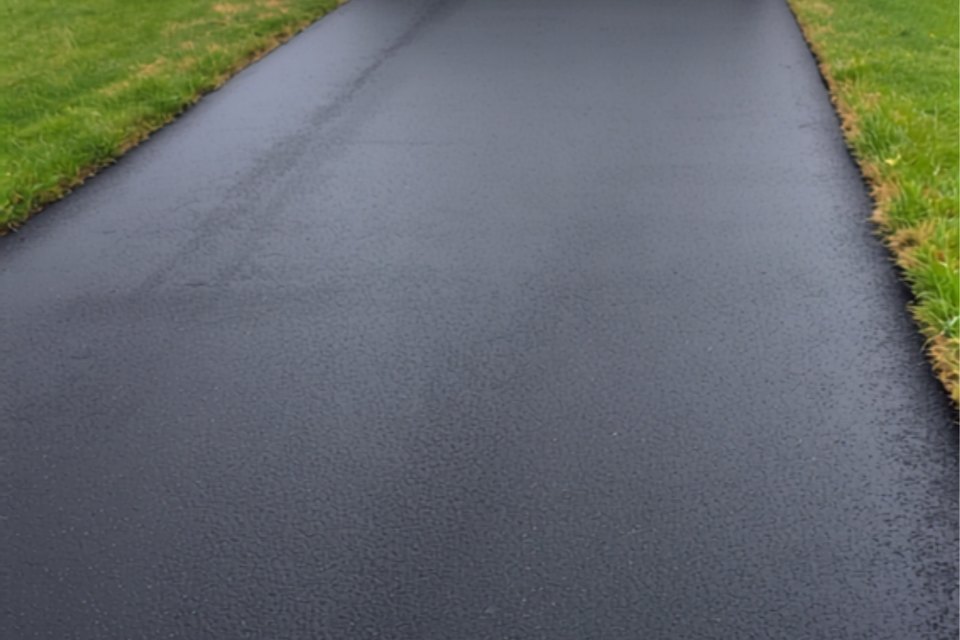
The cadence for a healthy driveway in central Ohio is every two to three years. Sealing every year is money wasted, and it is the most common thing that gets oversold in this trade. There is a reason it gets sold that way — sealcoating is a fast, repeatable, easy-to-schedule job, and a customer on an annual cycle is worth roughly three times a customer on a sensible one.
The reason annual sealing is waste is not just that the coating has not worn out yet. It is that coats accumulate. Sealer applied over sealer that is still largely intact does not wear in as a single surface; it builds a thickening layer of material that is more brittle than the asphalt it is sitting on, and thick accumulated sealer cracks in its own right. Those cracks are shallow and cosmetic at first, but a heavily over-sealed drive ends up with a spiderweb of hairline cracking in the coating and eventually with sections peeling off in sheets, which looks considerably worse than honest gray asphalt.
The right trigger is condition, not calendar. When the surface has gone from black to a medium gray, when water no longer beads on it and instead darkens straight into the surface, when the aggregate at the surface is starting to show its texture — that is a drive asking to be sealed. On most central Ohio driveways that lands somewhere in the two to three year range, faster on a drive that gets full sun all day, slower on a shaded one.
Traffic changes the answer too. A residential driveway carrying two cars is a different surface from an apartment entry drive carrying delivery trucks and a hundred residents, and a lot in heavy use will wear its coating off the drive lanes long before the parking stalls fade. It is normal and correct for a commercial lot to be on a shorter cycle than a driveway, and it is still not annual.
Crack Filling First, Then Seal
The order of operations is not negotiable and it is the second place sealcoating jobs go wrong. Cracks get filled first, they get time to set up, and then the surface gets sealed. Sealing over open cracks wastes the sealer and the visit.
The reason is what a crack does to a thin coating. Sealer bridging a quarter-inch crack is unsupported across the gap, and it is a film, not a membrane. The first cold snap contracts the asphalt, the crack opens, the film tears, and water is going into the crack again — except now it is doing so under a coating that hides how wide the crack has gotten. By the time it is obvious, a winter of freeze-thaw has already run its course in the base.
The threshold is the same as it is for any other repair conversation: anything wider than a quarter inch takes filler before winter, and certainly before sealer. Hairline cracks below that threshold are genuinely handled by the sealcoat itself, which is one of the legitimate small benefits of the coating. Anything you can get a car key into needs material in it first.
This is also why a sealcoating quote that does not mention crack filling deserves a question. It is not automatically a problem — a two-year-old drive may genuinely have nothing to fill — but on a drive that has been through six or eight central Ohio winters, a plan that goes straight to spraying is skipping the part that determines whether the work is worth anything.
Clean, Dry, and Warm Enough
Sealer has to grip the asphalt to work, and it grips asphalt, not what is lying on it. That means the surface gets cleaned first: blown clear of leaves and grit, edges cut back where grass has crept over the asphalt, oil spots scrubbed and treated with a primer so the sealer takes there, and the whole surface swept or power cleaned depending on condition. Sealer applied over dust is glued to the dust, and it lifts off in sheets the first time a car turns its wheels while stopped.
Dry matters as much as clean. Sealer is a water-based emulsion that cures by losing that water, so it cannot go down on a wet surface or into a forecast with rain in it. Rain on a coating that has not cured will wash it off the driveway and into the yard and the gutter, and the job has to be redone. A paving company that reschedules you because of a radar picture is doing the right thing, even when the sky over your house looks clear.
Temperature has a floor. Most sealer products require the surface and the air to be above roughly 50 degrees and staying there, with overnight temperatures not dropping near freezing, and the manufacturer's minimum is the real number. Below that the emulsion cannot cure properly; the water does not leave fast enough, and the coating stays soft, tracks under tires, and never develops its wear resistance. This is why sealcoating in central Ohio belongs inside the same rough April through October season as the rest of the trade, and why a warm week in March is not the invitation it looks like.
Humidity extends everything. A humid, still day in an Ohio August slows the water leaving the coating considerably, which is why cure time is quoted as a range rather than a number. Sun and a breeze cure a driveway quickly. Heavy air and shade do not.
Cure Time and the 24 to 48 Hour Rule
Stay off fresh sealcoat for 24 to 48 hours, longer in humidity. That means no cars, no foot traffic beyond what cannot be avoided, no bikes, no trash cans dragged across it, and nothing parked on it. This is the instruction most often ignored and it is the one most likely to ruin the appearance of an otherwise good job.
What happens when you drive on it early is specific and permanent. The coating is still soft, so tires — especially tires turning while the car is stopped — scuff the surface, push the sealer into ridges, and pull it away from the asphalt in patches. Power steering marks in fresh sealer do not heal. They stay as gray smears in the black for the life of the coating, and the only real fix is recoating.
The practical consequence is that sealcoating a driveway means planning where the cars go for two days. On a lot it means the work gets phased, section by section, so parts of the lot stay open while others cure, and it often means evening or weekend scheduling. That is a normal conversation to have when the work gets scheduled rather than a surprise on the morning of.
Full hardness takes longer than the drive-on window. The coating continues to harden for a couple of weeks after it looks finished, so it is reasonable to avoid the heaviest things you own on it for a while — a loaded dumpster, a moving truck, or trailer stands parked in one spot — and to be careful with sharp turns for the first few days.
Too Thick Is a Failure, Not a Bonus
More sealer is not better sealer, and a coat laid on heavy is a defect rather than extra value. This is worth knowing because a thick, glossy, deeply black driveway on the day of application looks like the best possible outcome and is frequently the opposite.
Sealer is designed to cure at a specified coverage rate — a given number of square feet per gallon of properly mixed material. Applied much heavier than that, the outside of the coating skins over before the water underneath can escape. What is left is a coating that is hard on top and soft beneath, and it cracks in a fine web as it finally shrinks, then loses adhesion and peels. Two thin coats cure correctly and outlast one thick one by a wide margin.
Over-dilution is the opposite failure and it is the one that is harder to see. Sealer concentrate is meant to be cut with a specified amount of water and sand. Cut heavier than that, it goes on looking perfectly black and wears off in a season, particularly in the wheel paths, because there were never enough solids in it to build a wear layer. A driveway that looked great in May and is gray in the tire tracks by October was almost certainly sealed with thin material.
Neither problem is visible to a homeowner on the day, which is an uncomfortable truth about this service. The things you can reasonably ask about are what product is being used, what the mix is, and whether the work is one coat or two — and then judge the result by how it looks after a full year rather than on the afternoon it was applied.
A New Driveway Has to Wait
Do not seal new asphalt. Fresh pavement needs time to cure and release the lighter oils in its binder, and a coating applied before that has happened traps them. The usual guidance is to wait somewhere in the range of six months to a year, through at least one full summer, before the first sealcoat.
Sealing too early causes two problems. The trapped oils keep the asphalt softer than it should be, and soft asphalt marks and scuffs under turning tires and holds the imprint of anything parked on it. And the sealer itself has trouble adhering to a surface that is still releasing oil, so the coating goes down over a slick film and does not grip.
There is a related point about a new drive that surprises people: a brand new surface does not need protecting yet. The binder is fresh, it has not oxidized, and the surface is dense and closed. The value of sealing rises as the asphalt ages, which is exactly backwards from how it is often sold to someone who has just spent real money on a new driveway and wants to protect the investment.
The same logic applies after any patch or full-depth repair. New asphalt in a patch needs its own curing time before the whole surface gets sealed, which is one reason repair and sealing are commonly scheduled as two visits in two different months rather than as one job.
Honest Benefits Versus What Gets Oversold
The honest benefits are these. Sealcoat slows oxidation, which is the main thing aging an otherwise sound surface. It keeps water out of the surface pores, which reduces raveling and takes some freeze-thaw damage off the table. It resists fuel and oil drips, which matters most in parking areas. It fills and hides hairline cracking below the quarter-inch threshold. It makes the surface easier to sweep and to plow. And it restores the black appearance, which is not a trivial benefit when a property's curb appeal is part of what it is worth.
What gets oversold is everything structural. Sealer does not add strength, it does not add load capacity, it does not stop a crack that is already moving, and it does not add fifteen years to a driveway. Claims about doubling the life of pavement are marketing rather than a measurable outcome. The realistic framing is that a surface that is sealed on a two to three year cadence, with its cracks kept filled, will outlast an identical surface that is left alone — and an asphalt driveway built right runs fifteen to twenty years in central Ohio, longer when it has been maintained that way.
The other oversell is the annual cycle discussed above, and the third is sealing a surface that should be repaired or replaced. If a driveway has widespread alligator cracking, a sealcoat is a cosmetic delay, and a paving company that takes the job without saying so is not doing you a favor.
On a commercial lot there is one more piece to plan for: striping comes off with the old surface and goes back on after the seal. Re-stripe after any sealcoat, and expect ADA stalls and fire lanes to be part of the layout rather than an afterthought — the layout is worth reviewing while the lot is blank, because it is the cheapest moment to change it.
Deciding Whether This Year Is the Year
Walk the surface and look at three things. First, color and texture: a black surface that still beads water does not need sealing, and a gray surface with visible aggregate texture does. Second, cracks: note anything wider than a quarter inch, because that is filling work that comes first regardless of whether you seal. Third, pattern: if you find interconnected webbed cracking in small pieces where cars sit, stop and get an opinion about the base before spending anything on a coating.
Then consider the calendar. Sealing works inside the same warm season as the rest of the trade, it needs a dry stretch, and it needs you to keep vehicles off for a day or two afterward. Early fall is a good window in central Ohio — the surface is warm, humidity is falling, and the coating is in place before the freeze-thaw season starts working on it.
If the answer is that the surface is sound and due, this is straightforward, worthwhile maintenance that costs a fraction of what pavement costs and genuinely extends its life. If the answer is that the surface is failing, the honest recommendation is to spend the money on repair instead and seal it in a later season once it is worth protecting.
A quote costs nothing. It comes from a local paving company that comes out, looks at the surface, and tells you which of those two situations you are in — pricing depends on square footage, condition, how much cleaning and crack work is needed and whether the area has to be phased, and none of that is decided by this site. Call (614) 618-4912 or send the details through the quote form and it goes to a paver working in central Ohio.
FAQ: Sealcoating in Columbus, Ohio
Does sealcoating fix cracks in my driveway?No. Sealer is a thin coating with no structural strength, and a crack sealed over is still a crack. It will open back through the coating the first time the asphalt contracts in cold weather. Cracks wider than a quarter inch get filled first as separate work, and then the surface gets sealed over the top of the completed repair.
How often should a driveway be sealcoated?Every two to three years on a healthy driveway in central Ohio. Every year is money wasted — the coating has not worn out yet and the excess builds up into a brittle layer that cracks and peels on its own. Judge by condition: when the surface has gone gray and stops shedding water, it is due.
Can you sealcoat a driveway that is falling apart?You can, but it does not accomplish anything. Sealer applied over alligator cracking, potholes or a failing base gives you a uniformly black surface with the same structural problems under it, and the damage comes back through within a season. If a drive is at that stage the money belongs in repair or replacement instead.
How long before I can drive on fresh sealcoat?24 to 48 hours, and longer in humid weather. Keep everything off it in that window — cars, foot traffic, bikes, trash cans. Driving on a soft coating scuffs it and power steering marks from tires turning while stopped will stay in the surface permanently. On a commercial lot the work usually gets phased so part of the lot stays open.
What temperature does it need to be to sealcoat?Generally above about 50 degrees for both the surface and the air, holding through the night, with the product manufacturer's minimum being the number that actually governs. Sealer is a water-based emulsion that cures by losing water, and below that range it never cures properly — it stays soft and tracks. That keeps sealcoating inside the roughly April through October season here.
My driveway was just paved. When can it be sealed?Wait. New asphalt needs to cure and release the lighter oils in its binder first, and the usual guidance is somewhere in the six month to one year range, through at least one full summer. Sealing too early traps those oils, keeps the surface soft, and gives the coating a slick film to try to grip. A new drive also does not need the protection yet.
Is more sealer better?No. Sealer is meant to go down at a specified coverage rate, and a coat applied too heavy skins over on top while the water underneath cannot escape, then cracks in a fine web and peels. Two thin coats cure correctly and last considerably longer than one thick one. A very glossy, deeply black finish on the day of application is not the quality signal people assume it is.
Will rain ruin a fresh sealcoat?Yes, if it lands before the coating has cured. Sealer is a water-based product, and rain on an uncured coat washes it off the pavement and leaves an uneven mess that has to be redone. That is why the work gets scheduled around the forecast and why a paving company will move the appointment when the radar says to, even on a day that looks fine.
Do I need to re-stripe the parking lot after sealcoating?Yes. The sealer goes over the old markings, so striping is part of the job on any lot. It is also the natural moment to review the layout, since ADA stalls and fire lanes have to be part of the plan and changing the arrangement is cheapest while the surface is blank.
Is sealcoating actually worth the money?On a sound surface, yes. It slows the oxidation that makes asphalt brittle, keeps water out of the surface pores, resists fuel and oil drips, and hides hairline cracking, for a fraction of what pavement costs. It is not worth the money on a surface that is structurally finished, and it is not worth the money every single year. Cadence and condition decide it.
Get a free quote on your driveway or lot
Call and describe the property, or send an email with the address and roughly what you are looking at. The request goes to a paving company working in Columbus and central Ohio. Quotes are free and the paving company prices the job after seeing it.