Home › Services › Asphalt Paving in Columbus, Ohio
Asphalt Paving in Columbus, Ohio
New asphalt is mostly what you never see. The black part is two to three inches thick. Everything that decides whether it lasts fifteen years or falls apart in five sits underneath it, and it gets built before a single ton of hot mix shows up.
What a Proper Asphalt Build Actually Is
Asphalt is not a coating. It is the top layer of a layered structure, and every layer below it is carrying load. Weight from a vehicle enters the mat, spreads out through the stone base, and lands on the native soil in a much wider, much gentler footprint than the tire that started it. When a drive or a lot fails early, that chain broke somewhere below the surface. The asphalt is almost never the thing that was wrong.
A correct build in central Ohio is roughly this: strip the topsoil and any soft material out, prove the subgrade underneath is firm, lay and compact six to eight inches of crushed aggregate on a residential drive, then place two to three inches of asphalt over it. Commercial lots step up from there, eight inches or more of stone and a thicker binder course anywhere trucks turn or sit. Those are not arbitrary numbers. They are what the local clay demands.
The reason to understand the sequence is simple. Two contractors can quote the same square footage and the same finished look, and one of them is building half the structure. Nothing on the surface will tell you which is which the day it is finished. You find out in the third winter.
Excavation and the Subgrade on Central Ohio Clay
Columbus sits on the glacial till plains. What is under the grass is heavy clay, sometimes with stone mixed through it, and clay has two habits that matter enormously here. It holds water rather than letting it drain, and it changes volume — it swells when it is wet and it shrinks in a dry August. A surface built directly on unprepared clay is built on something that moves.
So the first real work is excavation. Topsoil comes out entirely, because organic material decomposes and settles, and anything soft or spongy comes out with it. Depth depends on what the new surface has to carry: a car drive commonly gets eight to eleven inches of total excavation to leave room for the stone and the asphalt above grade, and a lot that takes delivery trucks gets more. The number is set by the build, not by habit.
Once the cut is made, the exposed subgrade gets compacted and inspected. A crew that knows the ground will roll it and watch. If a spot pumps — if the roller makes the ground flex and rebound like a sponge — that is a wet, unstable pocket and it does not get buried and ignored. It gets dug deeper and backfilled with stone, or stabilized, or in bad cases separated from the stone above with a geotextile fabric so the clay cannot migrate up into the base and contaminate it. Skipping this step is the single most common origin of a driveway that develops one sinking, alligator-cracked patch a few years later while the rest of it looks fine.
The Aggregate Base and Why Six to Eight Inches Matters
The stone base is the structural part of the job. Crushed limestone with a graded mix of sizes, placed in lifts and compacted, locks together into a layer that behaves almost like a slab — it spreads load sideways instead of driving it straight down into the clay. It also gives water somewhere to go rather than sitting directly against the underside of the asphalt.
Six to eight inches compacted is the residential standard here, and compacted is the operative word. Stone loses roughly a quarter of its loose depth when it is properly rolled, so eight inches dumped is not eight inches built. A crew working honestly places it in lifts of three or four inches and compacts each one, because a roller simply cannot densify a thick pile all the way through. The bottom of an over-thick lift stays loose, and loose stone under a hard mat is a void waiting to appear.
Thinner is where corners get cut, because stone is a real cost and nobody can see it once the asphalt is down. Four inches of base under a Columbus driveway will hold a sedan through a mild season and then crack in a line down the wheel tracks when the clay under it goes soft in a wet March. If you are comparing quotes, the base depth and whether it is measured compacted or loose is the most useful question you can ask.
Grade gets established in the stone, not in the asphalt. The base is shaped to the finished contours — pitched to drain, level across the width where it should be, feathered where it meets existing concrete — so the asphalt over it can be laid at a consistent thickness. Trying to fix a low spot by piling extra asphalt into it produces a soft patch that ruts.
Binder Course, Surface Course and Rolling While It Is Hot
Asphalt is crushed stone and sand held together with liquid asphalt cement, mixed hot at a plant and delivered hot. On most residential work in central Ohio it goes down in a single lift of two to three inches after compaction. On heavier work it is split into two: a coarser binder course underneath, which carries the structure, and a finer surface course on top, which takes the wear and sheds the water. Where trucks turn, the binder gets thicker, because turning is where the pavement takes the most punishment.
Temperature is the whole game during placement. Hot mix leaves the plant around three hundred degrees and it can only be compacted while it is still in a workable range. Once it cools past that window the aggregate stops moving and rolling it further does nothing except polish the surface. That is why crews work quickly behind the paver, why they care about haul time from the plant, and why a truck that sat too long in traffic is a problem rather than a delay.
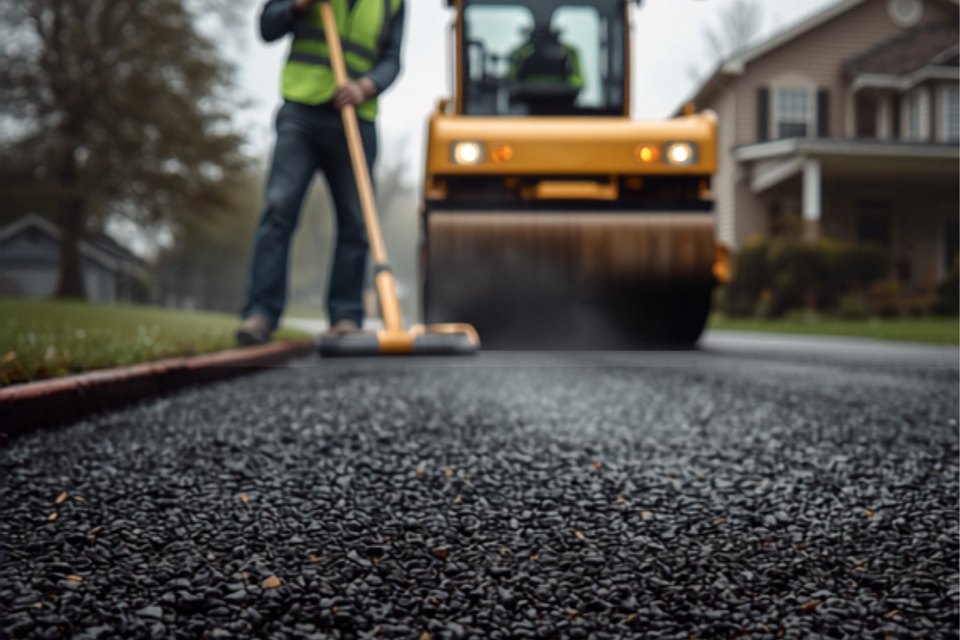
Rolling is what turns a placed mat into a durable one. The rollers make several passes, breaking down the mat and then smoothing it, driving the air voids down to a low percentage so water has nowhere to enter. An under-compacted mat looks fine and is porous, and a porous mat oxidizes fast, ravels at the surface and lets water reach the base. Two identical-looking driveways, one rolled properly and one not, will look completely different in five years.
When two lifts are used, the surface between them is cleaned and given a tack coat so the layers grip each other and act as one structure rather than two that slide independently. The same applies where new asphalt meets an existing edge.
Grading and Drainage: Water Has to Leave
Almost every asphalt failure in this area is a water failure with a delay built in. Water that stands on a surface finds its way into any small opening, and central Ohio winters cross through thirty-two degrees dozens of times in a single season. Each crossing freezes trapped water, expands it, widens the opening a little, then thaws and lets the water go deeper. That cycle, repeated, is what takes a hairline crack and turns it into a pothole.
So the design question before anything is poured is where the water goes. A surface needs pitch — a consistent slope that moves water off it and to a place that can take it. A rough working target is a quarter inch of fall per foot, enough to drain reliably and gentle enough that nobody notices. Flat looks fine on paper and ponds in reality, because no surface is perfectly flat after it settles.
The direction matters as much as the amount. Water pushed toward a garage, a foundation or a neighbor's lot is a problem that gets worse every year. Water pushed toward a lawn, a swale, a stone edge or an existing drain is handled. On tight city lots in places like Clintonville, German Village or Bexley, where the drive runs between two houses and there is nowhere obvious for it to go, the answer is sometimes a trench drain across the low end or a run of edge drain in the base, piped out to daylight. That is a design decision, and it belongs in the conversation before the quote is written, not after the first storm.
Under the surface, the stone base should also be able to shed water rather than hold it. Base that sits in a clay bathtub with no outlet stays saturated, and saturated base does not carry load.
Edges Are Where Asphalt Fails First
Look at any older driveway in central Ohio and the damage almost always starts at the outside edge. The reason is structural: in the middle of a mat, every direction is supported by more asphalt. At the edge, one side is supported by nothing but soil. Put a tire there and the material has room to move, flex, and eventually break off in crumbs.
A good crew treats the edge as a detail rather than a leftover. The mat gets a compacted taper on the outside — the edge rolled at an angle instead of left square — which gives it shape and strength and makes the transition to grass less abrupt. Then the shoulder alongside it gets backfilled with soil or stone brought up flush to the asphalt, so the edge is supported instead of hanging over an open drop. An unsupported edge with a three-inch drop beside it will be broken within a few seasons no matter how well the rest of the job was built.
Tie-ins are the other vulnerable seam. Where new asphalt meets a garage apron, a sidewalk, a concrete pad or an older section, the joint has to be cut clean and vertical, tacked, and compacted properly. A ragged joint left with a feathered thin edge of asphalt over concrete is going to break up, because an asphalt layer that thin cannot survive anything. Where the drive meets the street, the tie-in gets cut back to full-depth material and built to match, not smeared over the top.
The Paving Season and Temperature Limits
Central Ohio has a genuinely short window. The practical season runs roughly April through October, and the real requirement is not the air temperature on your phone — it is the ground. The base needs to be above fifty degrees and rising, because a cold base pulls heat out of the mat from below and shuts down compaction before the rollers can finish their work.
That is why the shoulder months are judgment calls rather than flat rules. A mid-April day at fifty-eight degrees with sun and dry ground can produce an excellent mat. A day in late October at the same air temperature, with the ground cooling and the sun low, may not, because there is no heat left in the earth and the mat stiffens in minutes. Crews watch thickness too: a thicker lift holds its heat longer and is more forgiving late in the year than a thin one.
Rain is a hard stop, not a preference. Asphalt cannot be placed on a wet base or into standing water, and a shower during placement can ruin a mat that was already down. An honest contractor will call off a day rather than lay a compromised surface, and pushing a crew to pave anyway in November because the schedule slipped is a way to buy fifteen-year work that delivers six. If the calendar has gotten away from a project, the better move is usually to do the excavation and base in the fall, drive on the compacted stone through winter, and pave in spring.
What a Good Crew Does Differently
The differences are unglamorous and they are all visible on the day of the work if you know to watch. They compact the subgrade and actually stop when a soft spot shows itself. They place stone in lifts and roll each one. They set grade with a string line or a laser rather than by eye. They protect the finished edge. They keep the paver moving at a steady rate, because stop-and-start placement leaves marks and density variations in the mat.
They also handle the small things at the perimeter: cutting sod back cleanly so the new surface has room, protecting the garage door and the siding from splash, cleaning the concrete at the apron before tacking it, and keeping the site tidy enough that the finished job does not need an afternoon of picking stone out of a lawn.
Before work starts, a few questions separate serious quotes from thin ones. How deep is the excavation and how much stone is going in, measured after compaction. Is the mat one lift or two, and how thick. Where does the water go, and what happens at the low corner. How is the edge being finished. What happens at the tie-in to the street and the garage. What is the plan if the subgrade turns out soft once it is open. A contractor who has real answers ready has built this before. One who answers all of it with a square-foot number has not thought about your particular property yet.
What the Finished Mat Should Look and Feel Like
New asphalt should be uniformly dark and tight-textured, with a consistent look across the whole surface. Small variations in texture happen, but a patchy appearance with coarse, open, stony areas next to smooth ones usually means the mix segregated — the larger stone separated from the fine material during handling — and those open areas will ravel first.
The surface should be smooth without being wavy. Sight down the length of it. Long gentle rolls in a drive are normal on uneven ground; abrupt dips, ridges at the roller marks, or a visible depression at a joint are not. Every seam should be tight and flat, not raised into a lip or sunken into a channel. Around drains and where the drive meets concrete, the transition should be flush.
The real test is the first hard rain. Walk out and look for standing water. Small damp patches dry off; a puddle that stays for hours is a low spot, and it is far easier to address in the first week than after it has been sitting through a freeze-thaw winter. A well-built surface sheds and is dry not long after the rain stops.
New asphalt stays soft for a while. It is drivable in a day or two for ordinary cars, but it keeps curing for weeks and it gets noticeably pliable on the first hot afternoons. During that period, keep off the edges, keep jack stands and trailer jacks and motorcycle kickstands off it or put a plate under them, and avoid turning the wheel while sitting still. Built right and treated sensibly, a driveway here runs fifteen to twenty years, longer if it gets sealed on a sane cadence and the cracks are kept shut.
Getting a Quote in Columbus and Central Ohio
Asphalt paving is priced off the actual property, because the things that drive cost are site conditions: how much material has to come out, how far equipment has to travel, how tight the access is, whether the existing surface needs removal and hauling, what the drainage situation requires, and how much stone the subgrade turns out to need. A square-foot number quoted over the phone before anyone has seen the ground is a guess in both directions.
Quotes are free, they come from a local paving company working in Columbus and central Ohio, and this site never prices the job. Call (614) 618-4912 or send the details through the quote form, and someone who paves for a living will look at the property and give you a real number with the build spelled out.
FAQ: Asphalt Paving in Columbus, Ohio
How thick should asphalt be on a driveway?Two to three inches of compacted asphalt over six to eight inches of compacted aggregate base is the standard for a residential driveway in central Ohio. The asphalt thickness gets most of the attention, but the stone underneath it is what actually carries the load. If a quote is thin anywhere, it is usually the base.
How long does a new asphalt driveway last in central Ohio?Fifteen to twenty years on a drive that was built right, and longer than that if it gets sealed on a reasonable cadence and cracks are filled before winter. Built on a thin or contaminated base, the same surface can be cracking in five. The difference is almost entirely in what happened below the mat.
When can I drive on new asphalt?A day or two for ordinary passenger cars. Stay off the outside edges for several weeks while the mat continues to cure, and keep concentrated point loads off it entirely in that period, including jack stands, trailer tongue jacks and kickstands. Avoid turning the steering wheel while the car is stopped, which twists the surface.
What months can asphalt be paved in Columbus?Roughly April through October. The requirement is ground temperature above fifty degrees and rising, not just a warm afternoon, because a cold base pulls heat out of the mat and stops compaction early. Late-season work is a judgment call that depends on the day, the thickness and the forecast.
Do I need to remove the old asphalt or can new go over it?It depends on the condition underneath. If the base is still sound and the surface is only worn or has isolated cracking, an overlay is a reasonable option. If it is alligator cracking across large areas, the base has failed and an overlay will mirror that failure within a couple of years, so it needs to come out and be rebuilt.
Why does my driveway crumble along the edge?Edges have support on one side only, so they are the weakest part of any asphalt surface. It gets worse when the edge was left square instead of tapered and rolled, and worse still when nothing was backfilled alongside it, leaving a drop that tires break off. Bringing soil or stone up flush to the edge after paving prevents most of it.
Why does central Ohio clay matter so much for paving?The region sits on glacial till, a heavy clay that holds water rather than draining it and changes volume with moisture. It swells when saturated and shrinks in a dry spell, so anything built directly on unprepared clay moves. That is why the topsoil comes out, the subgrade gets compacted and tested, and a properly compacted stone base goes between the clay and the asphalt.
What causes an asphalt surface to fail early?In this area it is almost always water, arriving through one of three doors: not enough pitch so it stands on the surface, a base that is too thin or contaminated with clay, or an under-compacted mat that is porous from day one. Winter does the rest, since the freeze-thaw cycle crosses thirty-two degrees dozens of times each season and widens every opening it finds.
How soon should new asphalt be sealcoated?Not right away. Fresh asphalt needs time to cure and release its oils, so sealcoating is generally held off until the surface has been through a season. After that, every two to three years on a healthy surface is the useful cadence. Doing it annually is money spent with nothing to show for it.
How is an asphalt paving job priced?By the property, not by a formula. Excavation depth, how much material has to be hauled away, access for equipment, the drainage work the site needs and the amount of stone the subgrade turns out to require all move the number. Quotes are free and come from a local paving company after someone has actually walked the site.
Get a free quote on your driveway or lot
Call and describe the property, or send an email with the address and roughly what you are looking at. The request goes to a paving company working in Columbus and central Ohio. Quotes are free and the paving company prices the job after seeing it.