Home › Services › Parking Lot Paving in Columbus, Ohio
Parking Lot Paving in Columbus, Ohio
A parking lot carries loads a driveway never sees and fails in places a driveway never fails. Here is how commercial, apartment and HOA paving actually gets specified, sequenced and maintained in central Ohio.
A Parking Lot Is Not a Big Driveway
The temptation is to think of a lot as a driveway with more square footage. It is not. A driveway carries passenger cars that arrive and leave along roughly the same line, and the heaviest thing that ever touches it is a delivery van. A parking lot carries box trucks, semis backing into a dock, a garbage truck that stops in the same footprint every week, and fire apparatus that has to be able to reach the building. The load is heavier, it is concentrated, and it lands in predictable places. That changes the section, the layout and the maintenance plan.
Turning is the other difference. A car rolling straight down a driveway pushes down. A loaded truck cutting a tight turn pushes down and sideways at the same time, and the sideways force is what shoves a thin mat into ripples and shears the surface away from the layer underneath. Anywhere the drive aisle meets an entrance, anywhere a truck swings around a corner of the building, anywhere a trailer pivots to line up with a dock, those are the spots where a lot built to residential spec starts coming apart in year three.
Fire lane geometry is engineering, not decoration. The lane has to be wide enough and the turning radii generous enough for apparatus to get through, and that lane has to still be structurally sound years later when it is actually needed. It also has to stay marked and stay clear, which is one reason striping belongs in the paving conversation instead of being treated as an afterthought once the blacktop cools.
What Goes Under the Blacktop: Base and Binder
Residential work in central Ohio is generally six to eight inches of compacted aggregate under two to three inches of asphalt. Commercial work starts at eight inches of aggregate and goes up from there, and in the truck lanes it goes up considerably. The stone is not filler. It is the structure. Asphalt is a flexible pavement, which means the surface spreads load down into the base and the base spreads it out into the subgrade. If the stone is thin or poorly compacted, the mat is being asked to do structural work it was never designed for, and it will crack in a web pattern to tell you so.
Above the stone, a commercial section is usually built in two lifts: a coarser binder course and a finer surface course. The binder carries the load, the surface sheds water and takes the wear. Where trucks turn and where they stop, a thicker binder course is cheap engineering compared to rebuilding that corner in four years. A good plan does not spec the same thickness everywhere. It spends material where the load actually lands and saves it in the car-only rows along the back of the property.
Compaction matters as much as depth. Central Ohio sits on glacial till, a heavy clay that holds water and moves with it. A base built on soft, wet subgrade will pump and settle no matter how many inches of stone sit on top. On a lot with known soft spots, undercutting and replacing the bad subgrade before any stone goes down is the difference between a twenty-year lot and a five-year lot. That work is invisible the day it is finished, which is exactly why a low bid tends to leave it out.
Where the Water Goes in a Flat Lot
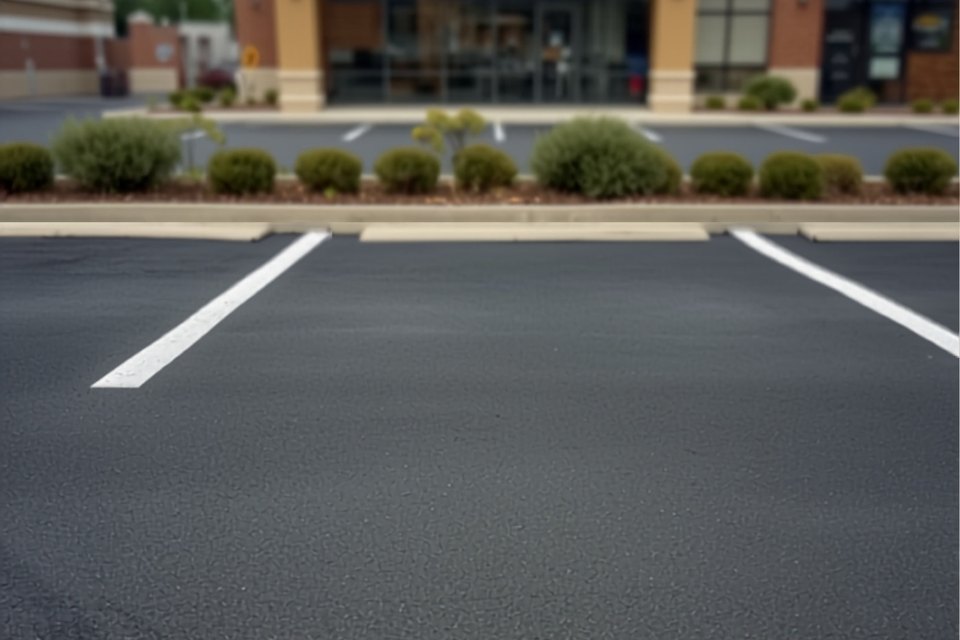
Water is what kills asphalt, and a flat lot is a machine for holding water. On a driveway, gravity usually solves most of the problem because there is fall from the garage down to the street. On an acre of parking, the fall has to be designed. Every square foot has to drain somewhere, and somewhere has to be a real place: a catch basin, a swale, a curb cut, a drainage course at the edge of the property.
Standing water is not just ugly. Water sitting on a seam or a crack works its way down into the base, and central Ohio crosses 32 degrees dozens of times in a single winter. Every crossing freezes that water, expands it, widens the void, then thaws and lets more water in. A birdbath that holds a quarter inch after an October rain is a pothole by March. When a lot is repaved, the low spots are the first thing to fix, because paving over a drainage problem only gives you a smoother drainage problem.
Catch basins deserve their own attention. The frames and grates get beaten by every truck that rolls across them, and the asphalt that abuts them is usually the first thing to unravel. Rebuilding the ring around a basin, cutting it square, resetting the casting to the right elevation and keying the new asphalt to it, is routine work on a resurfacing job and one of the places a cheap bid quietly skips. The same goes for curb reveal: if the new surface comes up too high, the curb stops holding water in the lane and starts letting it run over the top.
Dumpster Pads, Docks, and the Spots That Fail First
A garbage truck concentrates enormous load in one footprint, repeatedly, in the same spot. It backs in along the same line, its rear axles park in the same two rectangles every week, and it lifts a full container overhead and sets it back down. No asphalt section is a good answer to that. The standard detail is a reinforced concrete pad sized for both the container and the truck's rear axles, with the asphalt keyed into the pad edge, because concrete handles static point load and asphalt does not.
The pad has to be big enough to matter. A pad that only covers the container leaves the truck's rear wheels sitting on blacktop right at the pad edge, which is the worst of both worlds: a hard edge to push against and a soft material to push into. The approach apron counts too, since that is where the truck brakes hard and where a thin surface gets shoved forward into a washboard.
Loading docks are the same problem in a different shape. A trailer sitting on its landing gear puts thousands of pounds through two small steel feet, and it sits there for hours at a time. The dock approach is another candidate for concrete, or at minimum for a heavily thickened asphalt section. Anywhere a trailer parks, a container sits, or a truck idles in one place for a long stretch is a place where blacktop alone is the wrong material. That is worth knowing before the bids come in, because a bid that details those areas and a bid that does not are not comparable numbers even when they cover the same square footage.
Phasing the Work So the Property Stays Open
The real constraint on a commercial lot is almost never the paving. It is that the property has to keep operating while the paving happens. A restaurant needs its drive-through lane. An apartment community has residents who need somewhere to put a car tonight. A medical office needs its accessible stalls available every single day it is open. That means the work gets planned in phases before anyone shows up with a truck.
Phasing starts with a map of the lot broken into sections, an order of operations, and a parking plan for each stage. Typically the far rows go first while everyone parks near the building, then the near rows while everyone parks on the finished far rows. Entrances get done in halves so the property never loses access entirely. Barricades, cones and signage are part of the job, and so is telling tenants and customers what is happening and when, which is the single largest source of complaints when it gets skipped.
Timing is the other lever. A great deal of commercial paving happens on nights and weekends for exactly this reason: an office park is empty from Friday evening to Monday morning, and a retail lot is quietest overnight. Ask whether the work can be sequenced around your business hours, and ask which phases genuinely need daylight. Asphalt can be laid at night in warm weather, though the window narrows as the season cools, because the mat needs ground above 50 degrees and rising and it loses heat faster after dark. Between roughly April and October the schedule has room. Outside that, the calendar starts making decisions for you.
Striping, Layout, and Accessible Stalls
Paint is the last five percent of the job and the first thing anyone notices. New asphalt has to cure before it will hold a stripe, and any sealcoat wipes the layout off entirely, so re-striping is not optional after sealing. It is the second half of the same job, and it should be planned and priced alongside it rather than discovered afterward.
A re-stripe is also the cheapest opportunity anyone gets to fix a layout. Stall widths, aisle widths, the direction of traffic flow, where the loading zone sits, whether the corner everybody clips should simply become a painted island, all of it is decided by where the paint goes, and the lines are already coming off. If a lot has been striped the same way since the building went up, it is worth asking whether the layout still matches how the property is actually used now.
Accessible stalls and access aisles belong in the plan from the start, not bolted on at the end. That means the right count of stalls for the size of the lot, the right share of them van-accessible, the access aisle striped and kept clear beside the stall, the route from the stall to the door as flat as the site allows, and the signage standing where it belongs rather than painted on a surface that snow covers. Slope matters more here than anywhere else on the property, which is one more reason accessible stalls get placed during design instead of after the paint truck arrives. Fire lanes get the same treatment: marked, dimensioned and kept open. Yes, including accessible stalls and fire lanes, is the correct answer when you ask a contractor what the striping scope covers.
Apartment, Multifamily and HOA Drives
Apartment and condominium properties are their own animal. The drive aisles see delivery vans, moving trucks and weekly garbage service, so they need commercial thickness. The parking bays themselves mostly see cars and can often be built lighter, which is where a smart spec saves real money on a large property. Speed tables, entry aprons at the street, mail kiosk pull-offs and carport bays each have their own details and each deserve a line in the scope.
The operational problem is cars. A residential lot is full at night and empty during the day, which is the exact opposite of a retail lot, so the phasing plan inverts: work the resident rows from mid-morning to mid-afternoon and get them back open before people come home. That takes notice on doors, notice through whatever app the property uses, and a plan for the cars that do not move anyway. Ask how a contractor handles vehicles still sitting in a section when the crew arrives, because every complex has a few.
Community associations decide differently than a business owner does. A board is spending other people's money, usually against a reserve schedule, and usually has to show the membership why. That argues for a written scope that spells out depths, square footages and details area by area, so the board can compare bids on the same terms and put real numbers into a reserve study instead of a guess. Ask about handling the whole portfolio of drives and bays on one schedule rather than a patch here and a patch there, since mobilizing once for a larger scope is generally cheaper than mobilizing three times for small ones.
Resurface, Patch, or Rebuild
Three different problems all get reported as the lot needs paving. Surface wear, meaning gray, dry, raveling asphalt with cracks that run in long straight lines, is a surfacing problem and usually an overlay. Localized failure, meaning one soft corner, one sunken area beside a basin, one alligatored patch at a dumpster approach, is a repair problem, and the fix is to cut that area out full depth, rebuild the base under it and patch. General alligator cracking across whole rows is a base problem, and neither an overlay nor a patch will hold it.
Alligator cracking means the base has failed. That interlocking web of small pieces is what a surface does when it flexes under load with nothing solid underneath. Paving over it lays two new inches on a foundation that is already moving, and the pattern reflects through within a season or two. On a lot the right answer is frequently mixed: full-depth removal and rebuild in the truck lanes and the failed areas, mill and overlay across the car rows that are still sound, crack fill and patching to carry the rest a few more years.
Getting that call right requires walking the property rather than squinting at a satellite photo. Cores, or at minimum a look at the existing depth where the pavement is exposed at an edge, say what is actually down there. On a large property the honest answer is often a multi-year plan with the worst section rebuilt first, and that plan is easier to fund than a single enormous number.
Maintenance on a Schedule, Not in a Crisis
The expensive way to own asphalt is to do nothing until something fails and then pay for structural repair. The cheap way is a calendar. Crack fill as needed, because anything wider than a quarter inch takes filler before winter and an open crack is a funnel straight into the base. Sealcoat every two to three years on a healthy lot, since every year is money wasted and only builds up brittle film. Re-stripe after every seal. Sweep the surface, keep the basins clear, and cut back the landscaping that drips onto the pavement edge and keeps it wet.
Salt is worth understanding correctly. Franklin County runs salt and brine all winter and it arrives in every lot on tires. Salt itself does not eat asphalt the way it attacks concrete and steel. What it does is keep water liquid at temperatures where it would otherwise be frozen and inert, so the pavement gets many more freeze-thaw cycles than the air temperature alone would produce. The damage is mechanical, and the defense is the same as always: keep water out, keep cracks shut, keep the lot draining.
A lot built right and maintained runs fifteen to twenty years before it needs anything beyond surface work, and longer if it is sealed and the cracks are kept shut. A lot that gets attention only when a tenant complains about a pothole tends to need a full rebuild in half that time. The difference is not luck and it is not the weather. It is whether anyone ever wrote down a plan and stuck to it.
Getting a Real Number on the Work
Every lot gets priced after somebody walks it. Square footage is only the starting point. The number moves on access for equipment, on thickness, on how much of the existing surface has to come out, on how many basins need rebuilding, on whether the work has to happen at night, and on how many phases the property requires. Anyone who prices a commercial lot off an aerial image is guessing, and the guess tends to get corrected after the contract is signed.
When you collect bids, ask each contractor to break the scope out by area with depths and square footages written down, ask what happens if something gets damaged, ask to see the paperwork behind the company, and ask what specifically made them recommend an overlay in one area and a rebuild in another. Bids that describe the same work in the same terms can be compared. Bids that are a single lump sum cannot.
Quotes are free and they come from a local paving company, never priced by this site. Call (614) 618-4912 or send the details through the quote form. The useful details are the approximate size of the property, what the surface is doing, whether trucks use it and where they turn, and any hours the work absolutely cannot happen. Somebody will come look at it and give you a straight read.
FAQ: Parking Lot Paving in Columbus, Ohio
How long does it take to pave a parking lot?It depends on size, on how much of the old surface has to be removed, and on how many phases the property needs. A small lot done in one piece can be milled and paved inside a day or two. A large property worked in sections so it never fully closes can run a week or more of calendar time while only a portion of it is out of service on any given day. The phasing plan, not the paving itself, usually sets the schedule.
Can the work be done at night or on a weekend?Often, yes, and for retail and office properties it is common. An office park is empty from Friday evening to Monday morning and a retail lot is quietest overnight. Night work does need warm weather, because the mat needs ground above 50 degrees and rising and the surface gives up heat faster after dark. Ask early whether the work can be sequenced around your business hours so it can be built into the plan instead of squeezed in later.
Do we have to close the entire lot?No. Commercial lots are normally phased so the property stays open. The lot gets broken into sections with an order of operations and a parking plan for each stage, entrances get done in halves so access is never lost, and cones, barricades and signage move with the work. What matters most is giving tenants and customers notice of which section is closed and when.
How thick should a commercial parking lot be?Commercial work starts at eight inches or more of compacted aggregate, with a thicker binder course where trucks turn and stop. That is heavier than residential, which is typically six to eight inches of aggregate under two to three inches of asphalt. The right spec is not uniform across a property either. Truck lanes, entrances and dock approaches carry far more load than the car rows at the back, and a good plan puts material where the load actually lands.
Why does the dumpster area always fail first?Because a garbage truck concentrates enormous load in one footprint, repeatedly, in the same spot, and then lifts a full container overhead and sets it down again. Asphalt is a flexible pavement and it does not handle static point load well. The usual answer is a reinforced concrete pad sized for both the container and the truck's rear axles, with the asphalt keyed into it, and an approach apron that accounts for where the truck brakes.
Do we have to re-stripe after sealcoating?Yes. Sealcoat covers the existing layout completely, so the lines have to go back down afterward. Treat striping and sealing as one job and price them together. It is also the cheapest chance you will get to change the layout, since stall widths, traffic flow, loading zones and islands are all just decisions about where the paint goes, and the old lines are already gone.
Are accessible stalls and fire lanes part of the striping?Yes, including accessible stalls and fire lanes. That covers the right count of accessible stalls for the lot size, the correct share of them van-accessible, the access aisle beside the stall, signage standing where it belongs, and the fire lane marked and dimensioned. Slope matters for accessible stalls more than anywhere else on the property, so their placement belongs in the design stage rather than at the paint truck.
How often should a commercial lot be sealcoated?Every two to three years on a healthy lot. Annually is money wasted and just builds up a brittle film that cracks on its own. Crack filling runs on a different cycle and should happen whenever cracks open past a quarter inch, ideally before winter, because an open crack is a direct path for water into the base and central Ohio crosses 32 degrees dozens of times each winter.
When can cars drive on new asphalt?Generally a day or two for passenger cars. Keep traffic off the edges, which have no confinement and will crumble under a tire that runs off the side, and keep point loads such as trailer jacks and equipment stands off the new surface for a few weeks. Heavier truck traffic should wait longer where possible, and the contractor doing the work should tell you which lanes to hold back the longest.
Does this cover apartment and HOA properties?Yes. Apartment and multifamily lots, condominium drives and community-association roadways are all in scope, along with commercial lots. Public streets, highways and DOT work are not. On residential properties the phasing plan inverts compared to retail, since the lot is full at night, so resident rows generally get worked mid-morning through mid-afternoon and reopened before people come home.
Get a free quote on your driveway or lot
Call and describe the property, or send an email with the address and roughly what you are looking at. The request goes to a paving company working in Columbus and central Ohio. Quotes are free and the paving company prices the job after seeing it.